
Integrating Solar Power Into Greenhouse Operations
Table of Contents
- Solar-Powered Greenhouse Ventilation Systems That Actually Work
- Off-Grid Greenhouse Electricity Requirements: How Much Power Do You Need?
- Cost-Benefit Analysis of Solar Greenhouse Integration
- Integrating Solar Power Into Greenhouse Operations: Panels, Inverters, and Structural Load
- Retrofitting vs. New Construction: Which Path Fits Your Greenhouse?
- Maintenance, Cleaning, and Regulatory Hurdles for Solar Greenhouses
- Frequently Asked Questions
Last Updated: September 22, 2026
Solar-Powered Greenhouse Ventilation Systems That Actually Work
Integrating solar power into greenhouse operations starts with ventilation: photovoltaic panels drive exhaust fans and automated vent actuators, cutting the grid electrical load.
Sizing Fans and Vents to Your Greenhouse Volume
Fan capacity is measured in cubic feet per minute, targeting one full air exchange every 60 seconds in summer: divide greenhouse volume by 60 for minimum CFM. A 30-by-96-foot hoophouse with 10-foot walls holds roughly 28,800 cubic feet, needing about 480 CFM.
Wiring DC Fans Directly to Panels vs. Battery Banks
Direct-coupled DC fans are simplest: the panel powers the fan whenever irradiance is sufficient, with no battery, inverter, or maintenance.
Off-Grid Greenhouse Electricity Requirements: How Much Power Do You Need?
Off-grid greenhouse electricity requirements are every load multiplied by daily operating hours. Most growers overestimate panel needs and underestimate battery needs.
Calculating Your Daily Energy Load
List every device, its wattage, and daily runtime; multiply watts by hours for watt-hours.
| Load | Wattage | Hours/Day | Daily Watt-Hours |
|---|---|---|---|
| Exhaust fan (24 in.) | 250 W | 8 | 2,000 Wh |
| Circulation fans (x4) | 60 W | 12 | 720 Wh |
| Vent actuators | 40 W | 1 | 40 Wh |
| Irrigation pump | 400 W | 1 | 400 Wh |
| LED grow lighting | 300 W | 5 | 1,500 Wh |
| Controller and sensors | 15 W | 24 | 360 Wh |
| Total | 5,020 Wh |
Battery Storage Sizing for Climate Control
Climate control decides battery size because it cannot wait. A common approach sizes the bank for two days of autonomy on climate-critical loads only.
Cost-Benefit Analysis of Solar Greenhouse Integration
A cost-benefit analysis of solar greenhouse integration comes down to upfront spend and time to payback. Payback depends on whether you are offsetting grid power, replacing a generator, or avoiding a service connection. Load profile matters as much as total load: a greenhouse drawing most power in daylight gets more value from every panel.
Upfront Costs and Available Incentives
The federal investment tax credit for solar has historically covered a meaningful share of system cost for rooftop and ground-mounted arrays. Rules change, so confirm current terms with the IRS and a qualified tax professional. Many states add rebates, and USDA rural energy programs have supported agricultural solar for years. Get at least three quotes.
- Panels and racking typically make up the largest single line item, and racking cost swings hard between roof-mount and ground-mount.
- Inverter or charge controller is a smaller line item but the one most likely to fail first, so don't shop on price alone.
- Battery bank is the line item that scales fastest with autonomy days, and the one most growers underestimate.
- Balance of system, conduit, disconnects, combiner boxes, monitoring, is easy to overlook and adds up quickly on a retrofit.
- Labor and permitting varies by jurisdiction and by whether you are trenching for a ground-mount array.
Payback Periods for Hobby vs. Commercial Greenhouses
Hobby greenhouses rarely reach payback on electricity savings alone because their total bill is small. The savings that matter are avoided trenching and service connection costs. If quoted a five-figure trench and service upgrade, a modest off-grid array can pay for itself the day it is commissioned.
What Actually Moves the Payback Number
Four variables dominate payback and are worth pressure-testing before you sign anything:
- Your utility rate and rate structure. Demand charges, time-of-use windows, and standby fees can change the value of self-generated power dramatically.
- Your usable sun hours. A site with 4 sun hours needs a larger array than one with 5.5 to produce the same energy, and the difference shows up directly in upfront cost.
- Your autonomy requirement. Every additional day of battery autonomy adds cost without adding generation, so it lengthens payback unless it is replacing a generator or a service connection.
- Your maintenance discipline. Dirty panels and neglected batteries quietly erode the savings the payback math assumed.
Integrating Solar Power Into Greenhouse Operations: Panels, Inverters, and Structural Load
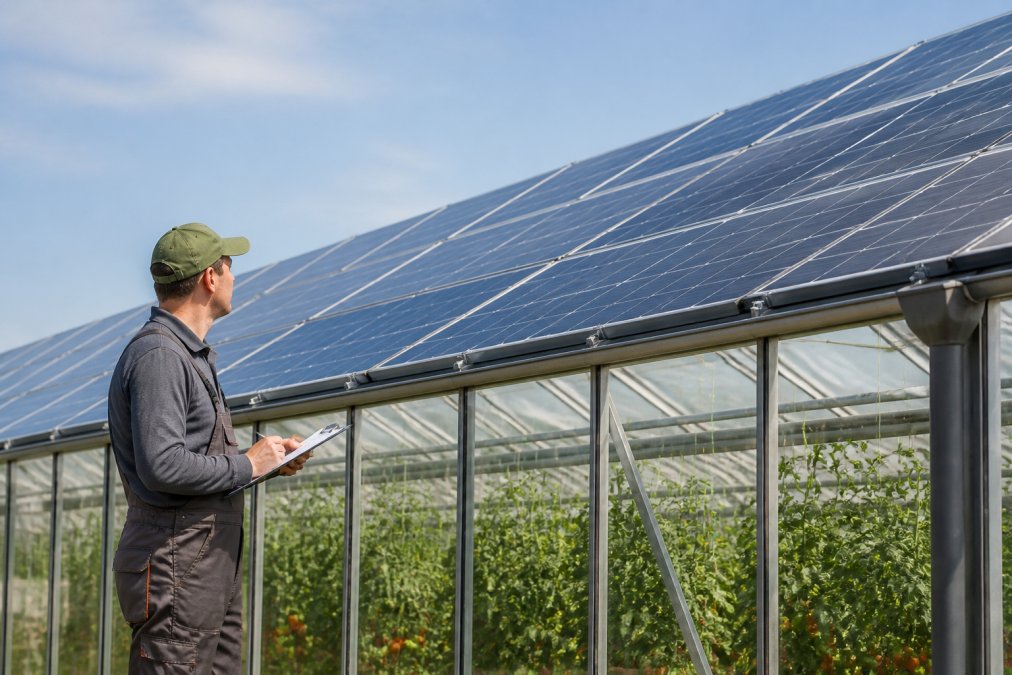
Integrating solar power into greenhouse operations at the hardware level means answering three questions: where panels go, how power gets converted, and whether the structure can carry the weight.
Roof-Mounted vs. Ground-Mounted Arrays
Roof-mounted arrays save space and shade the structure, helping summer cooling, but add dead load and wind uplift to a frame that may never have been engineered for either. Ground-mounted arrays are easier to install, clean, and expand later; they cost more in racking and land but put zero stress on the frame.
Semi-Transparent Panels and Light Modulation for Plant Growth
Semi-transparent photovoltaic panels replace glazing rather than sitting on top of it, generating power while transmitting sunlight to the crop below, attractive when you cannot spare roof area.
Retrofitting vs. New Construction: Which Path Fits Your Greenhouse?
Retrofitting an existing greenhouse is almost always cheaper than building new, but comes with constraints. The decision hinges on structure condition, electrical needs, and how much load you can shift to daylight hours.
The Retrofit Reality Check
Before pricing a single panel, answer three questions about your existing structure:
- Is the frame sound? Rust, rot, and fatigue at the connections are the deal-breakers. If the frame is compromised, roof-mounting is off the table and you are looking at a ground-mount array or a rebuild.
- What is the existing electrical service? A retrofit that ties into an undersized panel or a long, voltage-dropped feeder run can cost more to upgrade than the solar equipment itself.
- Where does the power need to go? Conduit runs through an existing greenhouse are the hidden cost of retrofits. Running cable through a structure full of irrigation lines, hanging baskets, and crop rows is slower and more expensive than roughing it in during construction.
What New Construction Lets You Design In
New construction makes sense when you are already replacing glazing or expanding, because you can design structural load, conduit runs, and battery room in from day one:
- Structural load designed in. Roof-mounted arrays add dead load and wind uplift. On a new build, the engineer accounts for both from the start instead of you paying for reinforcement later.
- Conduit and raceways roughed in. Pulling cable before the glazing goes on is a fraction of the cost of fishing it through a finished house.
- Battery and inverter space allocated. Batteries need temperature control and ventilation. A dedicated mechanical room designed into the plan is cheaper and safer than retrofitting one into a corner of the growing space.
- Roof pitch and orientation optimized. You can angle the structure for your latitude and your winter sun rather than accepting whatever the existing frame gives you.
- Semi-transparent glazing specified from the start. If you want photovoltaic glazing, it is a design decision, not a retrofit one.
The Middle Path: Phased Retrofit
A middle path works for many growers: retrofit ventilation and lighting loads now, and design the rest of the system for later expansion. Solar scales better when wiring and mounting infrastructure are sized for the final build, even if you install only part today.
- Size the conduit and disconnects for the final array, not the initial one. Conduit is cheap; re-trenching is not.
- Choose an inverter with headroom so you can add panels without replacing the electronics.
- Leave physical space for additional battery modules and a second array.
- Document what you installed, wire sizes, breaker ratings, mounting specs, so the next phase doesn't require reverse-engineering.
Which Path Fits Your Operation
- Retrofit if your frame is sound, your loads are modest, and you can ground-mount the array.
- New construction if you are already replacing glazing or expanding, and you want roof-mount or photovoltaic glazing.
- Phased retrofit if you want to start small but keep the door open to a full system later.
The worst outcome is a retrofit that boxes you in, undersized conduit, an inverter with no headroom, or a roof-mount array on a frame never engineered for it. Plan the final system, then install as much as your budget allows today.
Maintenance, Cleaning, and Regulatory Hurdles for Solar Greenhouses
Maintenance determines whether your system still performs in year ten. Panels lose output when dirty, and greenhouse environments are unusually dirty: pollen, dust, condensation drip, and crop debris all cut production.
Panel Cleaning and Inspection Schedules
Clean panels every four to eight weeks during the growing season, more often near agricultural dust or heavy pollen. Use plain water and a soft brush; never abrasive pads or harsh detergents, which damage the anti-reflective coating.
Inspect quarterly for the failures that matter:
- Check for cracked glass or damaged frames
- Verify all mounting bolts and clamps are tight
- Look for shading from new tree growth or structure changes
- Test battery voltage and terminal corrosion
- Confirm inverter fault codes are clear
- Check conduit and cable entries for water intrusion
Zoning, Permits, and Utility Interconnection
Most jurisdictions require a building or electrical permit for a solar array, and ground-mounted systems often trigger separate zoning review for setbacks and height. Start with your local planning office before ordering equipment.
Frequently Asked Questions
Can you run a greenhouse entirely on solar power?
Yes, a greenhouse can run fully off-grid with enough panels and battery storage, but the size of the system depends on your energy load. Heating and cooling draw the most power, while ventilation fans, grow lights, and irrigation pumps use far less. Most hobby greenhouses manage with a modest array and a battery bank sized for two to three days of autonomy, while commercial operations usually need a hybrid setup that keeps a grid connection as backup.
How do you calculate the solar capacity needed for greenhouse ventilation and lighting?
Start by listing every device and its wattage, then multiply by daily run hours to get your energy load in kilowatt-hours. Add a 20 to 30 percent buffer for cloudy days and system losses. Match that figure to panel output for your region's solar irradiance and pair it with a battery bank that covers at least two days of storage. An inverter sized above your peak simultaneous draw completes the system.
What are the primary benefits of solar-powered greenhouse climate control?
Solar-powered climate control reduces or eliminates monthly electricity bills, keeps ventilation and heating running during grid outages, and lowers your carbon footprint compared with fossil fuel generators. It also supports energy independence for remote sites where running power lines is impractical. Growers who pair solar with battery storage often find that operational costs stabilize, since fuel prices and utility rate hikes no longer affect day-to-day growing decisions.
Does the 33% rule apply to solar-powered greenhouse design?
The 33% rule is a rough guideline suggesting you size your solar array about a third larger than your calculated energy load to account for panel degradation, cloudy stretches, and efficiency losses through the inverter and wiring. It is not a formal standard, but it is a useful starting point. For greenhouses with heavy heating or cooling demands, many installers recommend a larger buffer, closer to 40 percent, especially in regions with long winters or frequent overcast weather.
