

How to Organize a Small Vegetable Garden Space
Table of Contents
- Assess Your Space and Sunlight First
- Plan Your Small Vegetable Garden Layout for Maximum Yield
- Best Vegetables for Container Gardening
- Vertical Gardening Ideas for Small Spaces
- Seed Storage Organization Tips for Small Gardens
- Common Mistakes to Avoid in a Small Vegetable Garden
- Conclusion: Start Small and Grow Smart
- Frequently Asked Questions
Last Updated: September 6, 2026
A small vegetable garden is a space where every inch counts, and how you arrange those inches determines whether you harvest a few salads or a season of meals. The difference between a chaotic patch of pots and a productive mini-farm isn't the size of your space; it's the system you put in place before the first seed goes in. This guide from Moderno Top Shop walks you through the exact steps to organize a small vegetable garden space so you maximize yield, minimize maintenance, and actually enjoy the process.
The core principle is simple: plan before you plant. Many gardeners skip straight to buying seedlings and end up with overcrowded containers, shaded tomatoes, and wasted soil. Below, we'll show you exactly how to assess, design, and maintain a compact growing area that produces consistently.
Assess Your Space and Sunlight First
Before you buy a single pot, you need to understand your microclimate. Organizing a small vegetable garden space starts with observation, not action. Track how many hours of direct sunlight your intended area receives during a typical summer day, because most fruiting vegetables like tomatoes and peppers need at least 6 to 8 hours, while leafy greens tolerate closer to 4.
Walk your space at 9 AM, noon, and 4 PM to map the light patterns. Note where walls, railings, and neighboring buildings cast shadows, as these create microclimates that shift with the seasons. A south-facing balcony is prime real estate for sun lovers, while a north-facing spot suits shade-tolerant herbs and salads. According to guidance on vegetable garden site selection from the USDA, proper sun exposure is the single most important factor in a productive garden.
Consider wind exposure and access to water, too. Rooftops and high balconies dry out faster and need sturdier supports. Measure your available floor and wall space in feet and inches, then sketch a rough map. This map becomes the foundation for every decision that follows.
Plan Your Small Vegetable Garden Layout for Maximum Yield
Once you understand your light, you can design a layout that turns every square foot into harvest potential. The most effective way to organize a small vegetable garden space is to group plants by their water and sunlight needs, then arrange containers so you can reach everything without stepping on soil. Place tall plants like pole beans or tomatoes at the north end so they don't shade shorter crops.
Group containers by watering frequency. Put thirsty plants like cucumbers and zucchini together, and keep drought-tolerant herbs like rosemary and thyme in their own zone. This prevents the common problem of overwatering one plant to please another. Leave a clear path for access, and position your compost or fertilizer within arm's reach of your main growing area.
The Square Foot Method for Small Gardens
The square foot method is a planning framework that divides growing space into 1-foot by 1-foot grids, each assigned to a specific crop based on its mature size. This approach eliminates wasted space and prevents overcrowding, which is the fastest way to invite disease and reduce yields. For a 4-foot by 4-foot bed, you get 16 distinct planting zones.
A common mistake is planting by seed packet spacing without considering the mature plant size. One tomato needs a full square foot; you can fit 16 radishes in the same area. This density planning is how you maximize output from a small vegetable garden. Use string or wooden slats to mark your grid, and assign each square a crop before you sow anything.
A Density Cheat Sheet for Common Container Crops
To make this concrete, here is a practical density reference for a standard 1-foot by 1-foot square in a raised bed or large container. These are mature-plant spacings, not seed-sowing spacings:
| Crop | Plants per Square Foot | Notes |
|---|---|---|
| Radish | 16 | Sow directly, harvest in 25 days |
| Carrot | 16 | Thin aggressively; roots need depth |
| Bush Bean | 9 | Needs support if it flops |
| Spinach | 9 | Cut-and-come-again harvesting |
| Leaf Lettuce | 4 | Harvest outer leaves weekly |
| Swiss Chard | 4 | One plant yields for months |
| Pepper | 1 | Use a 5-gallon container minimum |
| Determinate Tomato | 1 | Provide a sturdy cage; it will still sprawl |
| Basil | 4 | Pinch flowers to keep leaves coming |
| Cucumber (bush) | 1 | Train up a trellis to save floor space |
The Unique Angle: A Space Calculator for Real Balconies
Most layout advice assumes you have a square bed. But a small vegetable garden often lives on a narrow balcony or a fire escape, which is a rectangle. Here is a simple way to calculate your own planting capacity without a spreadsheet.
First, measure your usable floor space in square feet. Then, subtract 20% for access paths and pot edges. The remaining number is your "productive square footage." Now, apply this rule of thumb: a mature fruiting plant (tomato, pepper, eggplant) needs 1 square foot of footprint; a leafy green or root crop needs 0.25 square feet (4 per square foot); a climbing bean or pea needs 0.5 square feet if trellised vertically.
For example, a 3-foot by 6-foot balcony has 18 square feet. Subtract 20% for paths, leaving 14.4 square feet. You could allocate 4 square feet to tomatoes (4 plants), 2 square feet to peppers (2 plants), 4 square feet to a vertical trellis of pole beans (8 plants), and the remaining 4.4 square feet to a salad mix (about 17 plants).
This calculation is more useful than a fixed grid because it adapts to your actual footprint. It also forces you to make the trade-off explicit: every fruiting plant you add removes space for four salad plants. Write your numbers down before you buy anything.
Layout Patterns That Work on a Balcony
If you have a long, narrow space, avoid lining pots in a single row against the wall. This creates a dead zone in the middle and makes watering awkward. Instead, use a staggered double-row pattern. Place the tallest pots (tomatoes on cages) at the back, mid-height plants (peppers, bush beans) in the middle, and trailing or low plants (thyme, strawberries) at the front edge.
For a corner space, use an L-shaped arrangement. Put a vertical trellis on one wall and a tall pot in the corner, then angle the remaining pots to face the light source.
Group containers by watering frequency. Put thirsty plants like cucumbers and zucchini together, and keep drought-tolerant herbs like rosemary and thyme in their own zone. This prevents the common problem of overwatering one plant to please another. Leave a clear path for access, and position your compost or fertilizer within arm's reach of your main growing area.
Best Vegetables for Container Gardening
Not every vegetable is suited to small-space growing, so choosing the right species is half the battle. The best vegetables for container gardening are compact varieties bred for tight quarters, plus crops with shallow root systems that thrive in pots.
Look for variety names that include "bush," "compact," or "patio," as these are bred for container life. Herbs like basil, parsley, and cilantro also perform exceptionally well in pots. Avoid sprawling squash and indeterminate tomatoes unless you have serious vertical space and large containers.
Succession planting keeps your containers productive all season. After you harvest a crop of radishes or lettuce, immediately sow another round in the same pot.
Vertical Gardening Ideas for Small Spaces
When floor space runs out, the only direction left is up. Vertical gardening ideas for small spaces turn walls, railings, and trellises into productive growing surfaces, effectively doubling or tripling your available area.
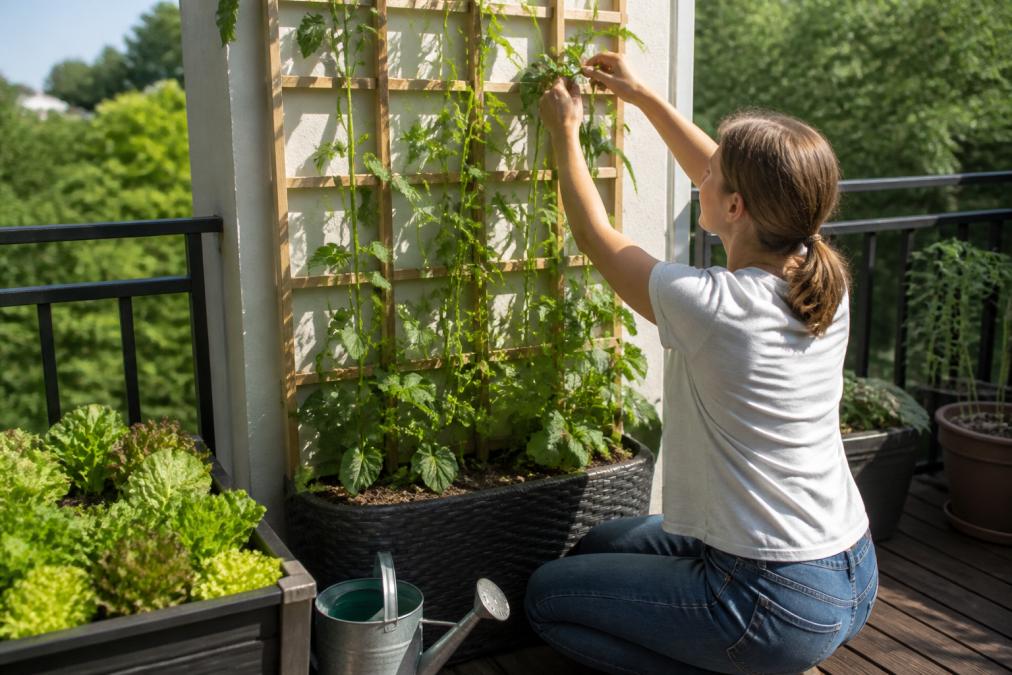
Install a sturdy trellis against a sunny wall, or use hanging planters for trailing herbs and strawberries. Pocket planters attached to a fence grow salad greens vertically without any floor space. Vertical structures also improve air circulation, which reduces the risk of fungal diseases.
A gutter system mounted on a wall creates a shallow, long channel perfect for shallow-rooted greens. Just ensure your supports can handle the weight of wet soil, which is surprisingly heavy. A single 4-foot section of guttering filled with soil can weigh over 20 pounds when saturated.
Seed Storage Organization Tips for Small Gardens
A disorganized seed stash leads to wasted money and missed planting windows. Seeds lose viability when exposed to heat, moisture, and light, meaning last year's unused packets may not germinate when you finally find them. The solution is a dedicated, airtight system that keeps everything sorted and visible.
Sort your seeds by category, such as leafy greens, root crops, and fruiting vegetables, then by planting season. Use clear, labeled containers so you can see what you have at a glance without rummaging.
The WALERICA Seed Organizer Kit from Moderno Top Shop is designed for exactly this purpose, holding up to 120 individual seed varieties in labeled vials within a water-resistant case. It eliminates the chaos of loose packets and ensures your collection is protected and ready when planting season arrives. For a small vegetable garden, this level of organization prevents buying duplicate seeds and guarantees you plant fresh stock each year.

Common Mistakes to Avoid in a Small Vegetable Garden
Most small-garden failures trace back to a handful of predictable errors. The most common mistake is overplanting, where gardeners sow more than the space can support, leading to stunted growth and disease. Respect the mature size of each plant, and trust the density plan you created earlier.
Another frequent error is using poor-quality soil or skipping drainage. Container gardens need a lightweight potting mix, not garden soil, which compacts and suffocates roots. Ensure every pot has drainage holes.
Neglecting consistent watering is a third major pitfall. Containers dry out much faster than in-ground beds, sometimes requiring water twice daily in peak summer heat. A simple drip irrigation system on a timer can solve this. Finally, don't ignore pest pressure; inspect leaves weekly and address issues early.
The Mistake Nobody Talks About: Ignoring the Visual Weight
Beyond the agronomic errors, there is a design mistake that undermines many small gardens: treating the space as a utility zone rather than a living area. When pots are mismatched, plastic trays are left visible, and plants are crammed without regard to height or color, the space feels chaotic. This is not just an aesthetic issue, it affects how often you want to spend time there, which directly impacts your maintenance consistency.
A simple fix is to choose a unified container palette. Instead of a jumble of terracotta, plastic, and ceramic, pick two colors or materials that complement your home's exterior. This is a low-cost change that transforms the perceived quality of the entire setup.
The Mistake of Ignoring Light Extremes
Most advice assumes you have a sunny spot. But many small gardens are on north-facing balconies or in shady courtyards. The mistake is trying to grow sun-loving crops in these conditions and then wondering why everything is leggy and tasteless. Instead, match your crop selection to your actual light.
For a space with less than 3 hours of direct sun, focus on leafy greens and herbs that tolerate shade. Arugula, mizuna, sorrel, and parsley will produce a steady harvest. For a space with 3 to 5 hours of morning sun, add peas and bush beans. For a space with intense afternoon sun and reflected heat from walls, choose heat-tolerant varieties like 'Sungold' cherry tomatoes, Swiss chard, and okra, and be prepared to water twice daily.
The Mistake of a Static Plan
A small garden is not a one-time layout; it is a dynamic system. The mistake is planting everything at once and then having nothing to do for two months. Instead, plan for succession from day one. When you harvest a pot of radishes, immediately sow a new round of lettuce in that same soil.
A practical way to manage this is to keep a simple calendar on your phone. Mark the expected harvest date for each container, and set a reminder to sow the next crop two weeks before that date. This "one pot, two crops per season" rule effectively doubles your yield without adding a single square foot of space.
The Mistake of Forgetting the Microclimate
Finally, many gardeners treat their whole balcony as one environment. In reality, a small space has multiple microclimates. The corner near the kitchen door may be warmer and more sheltered. The railing edge is windier and dries out faster.
Use this to your advantage. Place your most drought-sensitive plants (like lettuce) in the sheltered corner. Put your wind-tolerant herbs (like rosemary and thyme) along the exposed railing. This simple zoning reduces water stress and prevents the common failure of a single plant drying out while its neighbor is fine.
Conclusion: Start Small and Grow Smart
Organizing a small vegetable garden space is less about the size of your area and more about the clarity of your plan. By assessing sunlight, choosing the right containers and crops, building upward, and keeping your seeds organized, you create a system that produces food with minimal wasted effort.
The right tools make this process easier. The WALERICA Seed Organizer Kit from Moderno Top Shop keeps your seed collection protected, labeled, and ready for every planting window, so you can focus on growing rather than searching for lost packets. Get started with the WALERICA kit and turn your small space into a productive harvest this year.
Frequently Asked Questions
How do I maximize space in a small vegetable garden?
Maximize space by using the square foot method to plan dense plantings, installing vertical trellises for climbing crops, and choosing compact or dwarf vegetable varieties. Group plants with similar water and light needs together to make the most of every container and bed. Adding a small shelf or wall-mounted planter can also turn unused vertical areas into productive growing space.
What are the best vegetables to grow in a small home garden?
Leafy greens like lettuce and spinach, plus radishes and bush beans, grow quickly in small containers. Cherry tomatoes and peppers do well in larger pots with consistent watering. Herbs such as basil and parsley fit into tiny gaps between other plants. Choose determinate tomato varieties and compact pepper plants to keep your small vegetable garden manageable and productive all season.
What are the best vertical gardening techniques for small spaces?
Use wall-mounted trellises for vining cucumbers and peas, or install a freestanding A-frame trellis over a narrow planter. Tiered plant stands and hanging baskets for strawberries and trailing herbs work well on balconies. A simple wire grid attached to a sunny wall supports climbing beans. Vertical structures also improve airflow around leaves, which helps prevent common fungal issues.
