

Seed Storage Organizer: Easy Setup for Your Garden
Table of Contents
- Why Proper Seed Storage Matters for Your Garden
- Best Seed Storage Containers 2026: What to Look For
- How to Organize Garden Seeds with a Seed Storage Organizer
- Long-Term Seed Storage Tips for Maximum Germination
- Moisture Control: Keeping Seeds Dry in Humid Climates
- Small-Space Solutions for Seed Storage
- Conclusion: Start Your Easy-Setup Seed Storage System
- Frequently Asked Questions
Last Updated: September 11, 2026
Why Proper Seed Storage Matters for Your Garden
A seed storage organizer is a system that keeps every packet, envelope, and vial of seed labeled, dry, and findable so germination rates hold up season after season. Get it right and you plant with confidence. Get it wrong and you sow dead seed into good soil.

Here's the problem most gardeners run into. You buy seeds in spring, use half the packet, toss the rest in a shoebox, and find it a year later behind the potting bench. Germination drops, and you blame the seed company. The fault was storage.
Below, we'll cover the containers worth buying, the labeling systems that hold up, and the moisture-control habits that protect your collection.
Best Seed Storage Containers 2026: What to Look For
The best seed storage containers for 2026 balance three things: an airtight seal, a size that matches your collection, and a material that won't trap condensation. Skip any one of those and the container works against you.
Look for rigid containers with gasketed lids, or individual vials inside a sealed outer case. Flexible bags work for short-term holding, but they crush, tear, and hide what's inside.
Air-Tight vs. Breathable Containers
Air-tight wins for long-term storage. Seeds need low, stable moisture, and an airtight container holds whatever humidity level you establish inside it.
Breathable containers, like paper envelopes or cloth bags, suit short-term holding and seed swapping. They let moisture escape, which helps fresh, undried seed, but they also let humid air in. For anything you plan to keep past one season, seal it.
The one exception: never seal seed that isn't fully dry. Trap damp seed in an airtight jar and you've built a mold incubator.
Size and Capacity for Your Collection
Match capacity to your actual collection, not your aspirational one. A 30-variety gardener doesn't need a 200-slot case, and a serious seed saver will outgrow a small box in one season.
Collection Size |
Container Approach |
Why It Works |
|---|---|---|
Under 30 varieties |
Single small case with dividers |
Compact, cheap, easy to store |
30-120 varieties |
Multi-vial organizer with labeled slots |
One system, no lost packets |
120+ varieties |
Modular cases by plant family |
Scale without reorganizing everything |
Modular systems beat one giant box. When your collection grows, you add a case instead of rebuilding your whole system.
How to Organize Garden Seeds with a Seed Storage Organizer
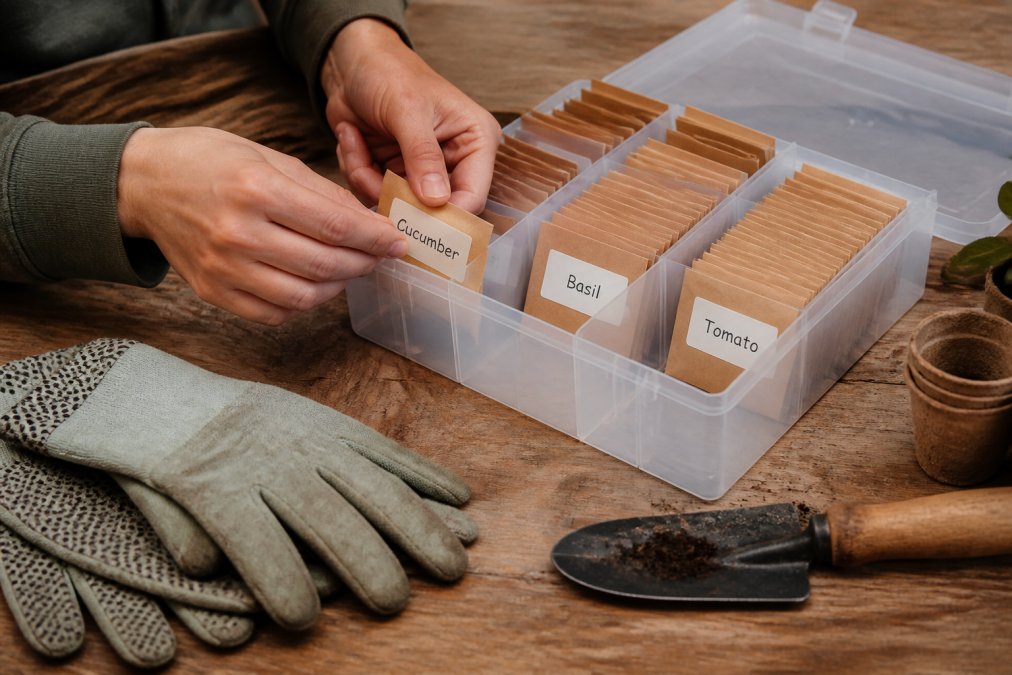
Organizing garden seeds comes down to one rule: every variety gets its own labeled slot, and every slot has a fixed home. Follow that and you'll never dig through a jumbled box again.
The WALERICA Seed Storage Organizer Kit from Moderno Top Shop handles up to 120 varieties with individual vials, so each packet stays organized and separated Setup takes minutes, no special tools required.
Labeling Systems That Actually Work
Pencil and permanent marker beat everything else. Pencil doesn't fade or run when humidity rises, and it survives the occasional damp wipe-down.
Record four things on every label:
- Variety name
- Year saved or purchased
- Source
- Expected germination window
Skip the year and you'll second-guess every old packet. A common mistake is labeling the container instead of the individual packet, which falls apart the moment you reorganize.
DIY Materials for Easy Assembly
You can build a working seed organizer from materials around the house. A sturdy cardboard box, small paper envelopes, and a set of dividers gets you started for almost nothing.
- Box: cigar box, photo storage box, or shoebox with a lid
- Dividers: index cards cut to height, or cardboard strips
- Envelopes: coin envelopes or small glassine bags
- Seal: a zipper bag or gasketed lid for the outer container
- Labels: pencil and masking tape
The DIY route works, but it has a ceiling. Cardboard absorbs humidity, paper envelopes tear, and nothing seals tightly. If you're storing more than a season's worth of seed, a purpose-built organizer pays for itself in saved germination.
Long-Term Seed Storage Tips for Maximum Germination
Long-term seed storage tips all point the same direction: cold, dark, dry, and stable. Change any one of those and shelf life drops.
Temperature, Humidity, and Desiccant Basics
The two levers you control are temperature and humidity. Cool and dry is the target; fluctuations do the damage.
A desiccant like silica gel pulls moisture out of the air inside a sealed container. Use food-grade silica packets, and recharge them periodically by drying them out. Replace them when they stop absorbing.
Seed Longevity by Type: A Quick Reference
Different seeds last different lengths of time under good storage. Here's a rough guide by category.
Seed Type |
Typical Storage Life |
Notes |
|---|---|---|
Beans, peas, legumes |
3-5 years |
Tougher seed coat, stores well |
Brassicas (broccoli, cabbage) |
4-5 years |
Reliable in dry conditions |
Tomatoes, peppers |
4-6 years |
Long-lived when fully dried |
Onions, leeks |
1-2 years |
Short-lived, replant fresh |
Parsnips, carrots |
1-3 years |
Decline fast, use early |
Lettuce, greens |
3-5 years |
Steady performers |
Treat these as ranges, not guarantees. Storage conditions move them more than the variety does.
Moisture Control: Keeping Seeds Dry in Humid Climates
Humidity is the number one killer of stored seed, and it's the hardest to fight in damp climates. The fix is a two-layer defense: a desiccant inside, a sealed barrier outside.
Start with fully dried seed. If you saved your own, dry it until a seed snaps rather than bends. Then seal it with a desiccant packet in an airtight container.
Avoid opening containers on humid days. Every time you break the seal, fresh moist air gets in. Pull what you need, reseal fast, and keep the container closed the rest of the time.
Small-Space Solutions for Seed Storage
A balcony, a single shelf, or a cabinet corner doesn't rule out a real system, it just changes the shape. The goal is a setup that mounts or stacks in under two square feet and assembles without drilling into a rental wall.
Pick the Footprint Before the Container
Measure your available space first, then match the container to it. Three common small-space profiles:
Space Available |
Best Fit |
Approximate Footprint |
|---|---|---|
One cabinet shelf |
Slim stackable case |
12 x 9 x 4 inches |
Under a bench or table |
Flat lidded box |
15 x 12 x 5 inches |
Wall or door gap |
Vertical hanging organizer |
6 x 20 x 3 inches |
Balcony rail or hook |
Small gasketed case in a tote |
10 x 8 x 6 inches |
A 120-slot case with individual vials typically fits in the cabinet-shelf profile. If your space is narrower than that, split the collection into two smaller cases rather than forcing one wide box.
Mounting Without Damaging the Wall
Renters and balcony gardeners can't always drill. Three no-damage options that hold a seed organizer:
- Over-the-door hooks, slide a hanging organizer onto a closet or cabinet door. No hardware, no holes.
- Adhesive strips rated for the loaded weight, check the strip's weight rating against the filled organizer, not the empty one. A full case of vials is heavier than it looks.
- Freestanding stack, set cases on a shelf or in a tote and stack upward. Zero mounting, zero risk.
If you can drill, a single shelf bracket above a workbench keeps the organizer at eye level and off the surface where potting soil lands.
Assembly That Fits a Small Space
Easy assembly matters more when you're working in a tight corner. Look for organizers that arrive pre-divided or snap together without tools, a case with molded slots takes seconds to set up, while a build-it-yourself grid takes half an hour and needs a flat surface you may not have on a balcony.
Group by planting season rather than alphabetically. Spring, summer, and fall sections mean you pull one small case per season instead of spreading the whole collection across a table. In a small space, that's the difference between a system you maintain and one you abandon.
Conclusion: Start Your Easy-Setup Seed Storage System
The hardest part of seed storage isn't the science, it's the habit. A labeled, sealed, organized system is the difference between planting with confidence and gambling on old packets.
Moderno Top Shop's WALERICA Seed Storage Organizer Kit gives you that system out of the box: 120 individual vials, included envelopes and labels, a water-resistant case, and setup that takes minutes. Whether you keep 30 varieties or 120, it turns a scattered collection into a ready-to-plant one.
Get your WALERICA kit and make every seed easy to find, easy to protect, and ready for planting season.
Frequently Asked Questions
What is the best way to store garden seeds for long-term viability?
Keep seeds in an airtight container in a cool, dark, and dry place. A dedicated seed storage organizer with individual vials or envelopes prevents moisture and light damage. Add a desiccant packet like silica gel to absorb residual humidity. For long-term storage, aim for temperatures below 50°F and humidity under 30%. Label everything with the variety name and date so you can track germination rates over time.
How do I build a DIY seed bank at home without spending much?
Start with a sturdy box or repurposed cabinet. Add small airtight containers like glass jars, plastic vials, or sealable bags. Use index cards or printable labels for organization. Store the box in a cool closet or basement. For easy assembly, choose a kit that includes pre-labeled envelopes and a compact case. A dedicated organizer reduces setup time to minutes and keeps everything visible, so you avoid digging through loose packets.
What are the best containers for organizing large seed collections?
Look for containers that are airtight, stackable, and divided into small compartments. Options include plastic tackle boxes, photo storage cases, or specialty seed organizers with 60 to 120 slots. Clear lids help you identify varieties without opening the container. Avoid cardboard boxes because they absorb moisture. If you have more than 100 varieties, choose a system with removable vials or envelopes so you can expand or rearrange easily.
How can I keep my seed packets moisture-free and labeled?
Transfer seeds from paper packets into airtight vials or sealable bags. Add a small silica gel packet to each container or to the main storage box. Label each container with the plant name, variety, and year using waterproof stickers or a permanent marker. Store the entire collection in a cool, dark spot away from fluctuating temperatures. Check periodically for condensation and replace desiccant as needed.
