
Best Seed Storage Containers 2026: Buyer's Guide
Table of Contents
- What to Look for in Seed Storage Containers
- Seed Storage Organizer: Choosing the Right System for Your Collection
- How to Store Seeds: Temperature, Humidity, and Light
- Seed Packet Organization: Labeling, Sorting, and Inventory
- Common Mistakes That Ruin Seed Viability
- Conclusion: Building a Seed Collection That Lasts
- Frequently Asked Questions
Last Updated: October 5, 2026
What to Look for in Seed Storage Containers
The best seed storage containers 2026 buyers can choose are the ones that block three things: moisture, heat, and light.

The container matters, but only when it works with the conditions around it.
The USDA Agricultural Research Service seed preservation guidance makes the core principle clear: seeds stay viable longer when held cool, dark, and dry. Everything in this guide flows from that single idea.
Material and Moisture Barrier
Moisture is the enemy that does the most damage, and material decides how well you block it. Airtight containers with a real gasket or screw-top lid beat hinged boxes with loose seams every time.
Here's the practical breakdown:
- Glass jars: Best moisture barrier, won't absorb odors, easy to see contents. Heavier and breakable.
- Rigid plastic with a gasket: Good barrier, lightweight, impact-resistant. Quality varies widely by brand.
- Paper envelopes: Breathable, so they need a secondary sealed container around them for long-term storage.
- Thin plastic bags: Poor barrier on their own. Fine as a first layer inside a sealed box.
A common mistake is trusting a container because it looks sealed. Run a simple test: close it, submerge it briefly, and check for water inside. If moisture gets in, so will humidity.
Capacity and Divider Systems
Capacity should match your collection, not the other way around. A gardener with 30 varieties doesn't need a 120-slot system, and someone with 200 packets will outgrow a small box fast.
Divider systems matter more than raw size. Individual compartments keep packets from mixing, so you never plant the wrong variety by accident. Look for:
- Fixed dividers for predictable, uniform packets
- Removable dividers when your collection changes size
- Individual vials or jars for maximum separation
| Container Type | Moisture Barrier | Best For | Reusable |
|---|---|---|---|
| Glass jar with lid | Excellent | Long-term storage | Yes |
| Plastic vial with cap | Very good | Individual varieties | Yes |
| Paper envelope | Poor alone | Short-term, in a sealed box | No |
| Compartment box | Good | Mid-size collections | Yes |
Seed Storage Organizer: Choosing the Right System for Your Collection
A seed storage organizer is a container system that separates, labels, and protects individual seed varieties in one place.
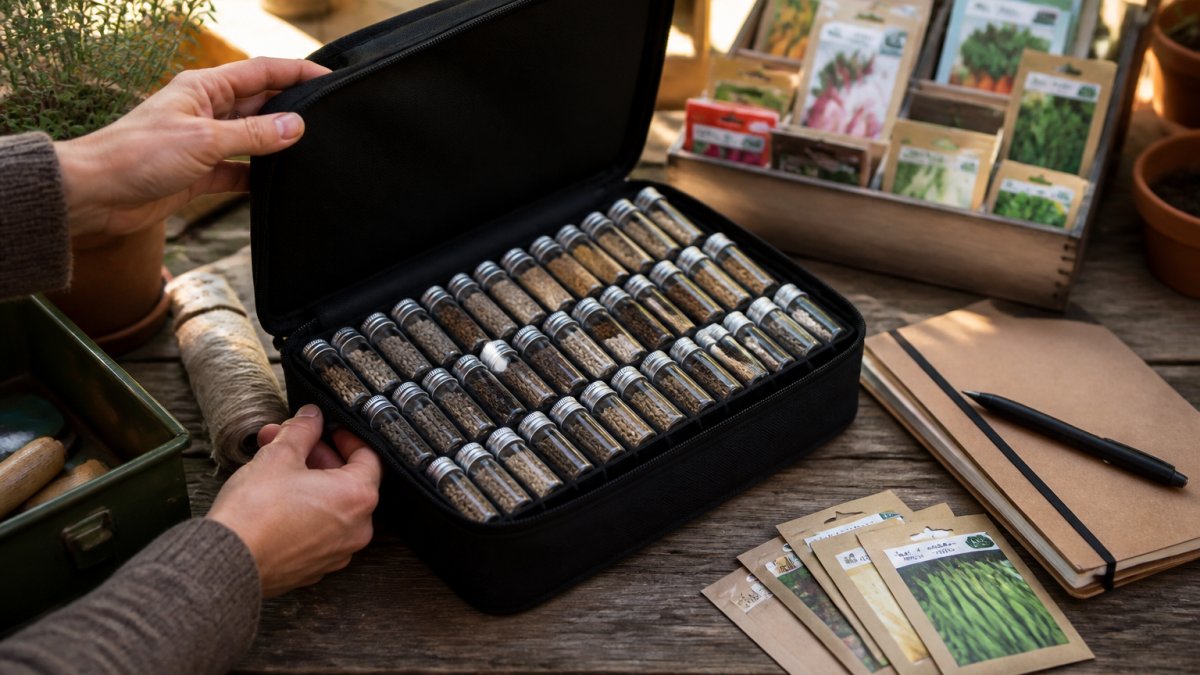
This is where most guides get vague. They tell you to "stay organized" without explaining what that looks like in practice.
For gardeners managing a serious collection, the WALERICA Seed Storage Organizer Kit covers all three.
The water-resistant, portable design matters if you store seeds in a greenhouse or move them between the house and the garden.
How Long Do Seeds Last? Storage Conditions by Species
Seed longevity varies enormously by species and storage conditions. Some seeds stay viable for years; others fade within a single season. Cool, dry, dark storage extends every one of them.
Here's the general pattern:
- Long-lived (5+ years): beans, cucumbers, lettuce, tomatoes, sunflowers
- Medium (3-4 years): peppers, carrots, peas, squash
- Short-lived (1-2 years): onions, parsnips, parsley, corn
These are tendencies, not guarantees. The same tomato seed stored in a cool basement outlasts one left in a hot shed. If you're unsure whether old seeds will sprout, run a germination test on a few before committing garden space.
How to Store Seeds: Temperature, Humidity, and Light
Storing seeds well comes down to controlling three variables at once. Temperature, humidity, and light all affect how long seeds stay viable, and they work together. Most top-ranking guides stop at "keep them cool and dry." This section gives you the measurable targets and the tools to hit them.
Evidence-Based Humidity and Temperature Targets
Seed banks operate on a well-established rule of thumb: every 1% drop in seed moisture content and every 10°F drop in storage temperature roughly doubles storage life. You don't need a walk-in cooler to benefit. You need numbers you can actually check.
- Relative humidity: Aim for 20-40% RH in the storage environment. Below 20% risks over-drying some seeds; above 50% invites mold and rapid viability loss.
- Temperature: A steady 50-70°F covers most home storage. Long-term seed bank storage runs near 32-41°F, but stability matters more than hitting a specific number.
- Seed moisture content: The target range for most vegetable and flower seeds is 8-12%. Seeds should feel dry to the touch and rattle, not bend.
How to Monitor Conditions
You can't manage what you don't measure. A few inexpensive tools close the gap between guessing and knowing:
- Digital hygrometer/thermometer: A $10-15 unit placed inside your storage container or cabinet tells you the actual RH and temperature. Check it monthly.
- Silica gel desiccant packs: Rechargeable packs (often color-indicating) absorb excess moisture inside sealed containers. Replace or recharge when the indicator changes color, typically every 2-6 months depending on your climate.
- Moisture test: Squeeze a seed between pliers. It should crack, not squash. A squash means too much internal moisture.
Refrigerator and Freezer Storage: Doing It Right
A refrigerator can work for long-term storage, but only if seeds are in a truly sealed container. Moisture from the fridge will ruin unprotected seeds. Let containers reach room temperature before opening them to avoid condensation on the seeds.
- Refrigerator (35-40°F): Good for extending viability of medium- and long-lived seeds. Use airtight glass jars or vacuum-sealed bags. Avoid the door.
- Freezer (0°F or below): Best reserved for long-term seed bank-style storage. Seeds must be fully dry (below 8% moisture) before freezing, or ice crystals will destroy cell walls. Thaw containers sealed, then open only after they reach room temperature.
Species-Specific Longevity Under Good Storage
Storage conditions change the math, but species sets the ceiling. Under cool, dry, dark conditions:
WALERICA Seed Storage Organizer Kit with 120 Seed Containers – Seed Organizer →
- Long-lived (5+ years): beans, cucumbers, lettuce, tomatoes, sunflowers, beets
- Medium (3-4 years): peppers, carrots, peas, squash, brassicas
- Short-lived (1-2 years): onions, parsnips, parsley, corn, leeks
A tomato seed stored at 50°F and 30% RH can outlast the same seed in a hot shed by several years. If you're unsure whether old seeds will sprout, run a germination test on a few before committing garden space.
Seed Packet Organization: Labeling, Sorting, and Inventory
Seed packet organization is what turns a pile of envelopes into a usable collection. Sort first, label second, and keep a simple inventory so you know what you have. Most guides stop at "label your seeds." A complete system tracks five data points per variety and keeps them readable for years.
The Five Fields Every Label Should Carry
A label that just says "tomato" is useless two seasons later. Record these five fields on every container:
- Variety name, the full cultivar name, not just the species (e.g., "Cherokee Purple," not "tomato")
- Source, where you got it: seed company, saved from your garden, traded, etc.
- Harvest or purchase year, the year the seed was produced or bought, not the year you filed it
- Viability window, the expected last-good year based on species (e.g., "good through 2029" for a tomato saved in 2026)
- Storage location, which box, bin, or shelf, so you can find it without emptying everything
Label Materials That Survive
Paper labels fade, smear, and fall off. Use these instead:
- Paint pen on glass or hard plastic: Permanent, waterproof, and won't peel. Write directly on the jar or vial.
- Laser-printed labels on polyester stock: Resistant to moisture and smudging. Inkjet on paper is not.
- Pencil on freezer tape: Simple, cheap, and survives humidity better than ballpoint ink.
Avoid adhesive labels on containers that will be handled often, corners lift, and once a label peels, the seed becomes a mystery.
Sorting: A System That Scales
Start by sorting seeds by plant type, then by variety. Vegetables in one section, flowers in another, herbs in a third. Within each group, alphabetical order saves time when you're planting.
For collections over 50 varieties, consider a two-tier system:
- Tier 1, Active rotation: This season's seeds, stored in your primary organizer within easy reach.
- Tier 2, Archive: Older or backup seeds, stored in a separate sealed container in a cooler spot. Check viability annually.
Building a Working Inventory
A basic inventory can be a notebook or a spreadsheet. Track variety, year, quantity, and where it's stored. This is where the WALERICA kit's included notebook is useful: your records stay with your seeds instead of in a drawer somewhere.
A simple spreadsheet with these columns covers almost every home gardener:
| Variety | Source | Year | Qty | Viability Through | Location | Last Germ Test |
|---|---|---|---|---|---|---|
| Cherokee Purple | Saved | 2026 | ~40 | 2030 | Box A, row 2 | 2026: 92% |
| Provider Bean | Seed Co. | 2025 | ~80 | 2029 | Box A, row 4 | 2026: 88% |
Update the inventory once a year, ideally in late winter before you start seeds. Note what you planted, what germinated poorly, and what needs replacing.
The Annual Seed Audit Checklist
- Sort seeds by plant type
- Label each container with variety, source, year, and viability window
- Record everything in an inventory (notebook or spreadsheet)
- Add a desiccant pack to each sealed container
- Store in a cool, dark, dry spot
- Run germination tests on anything past its viability window
- Cull or compost seeds that fail the test
- Note varieties to reorder before spring planting
Common Mistakes That Ruin Seed Viability
Most seed losses trace back to a handful of avoidable mistakes. Fix these and your collection will outlast the packaging it came in.
The biggest one is storing seeds in a hot, humid place. A garage or shed that swings between temperatures is the worst option, even though it feels convenient. The second is using containers that don't actually seal. The third is skipping labels, which makes old seeds a guessing game.
- Storing in a hot garage or damp basement corner
- Using scented or chemical-exposed containers
- Forgetting to label, then planting mystery seeds
- Opening sealed containers in humid weather without letting them adjust
- Keeping seeds past their viable window without a germination test
Never store seeds in the refrigerator door. The constant temperature swings from opening and closing the door shorten viability faster than steady cool storage.
Conclusion: Building a Seed Collection That Lasts
Keeping a collection alive for years takes the right container and the right habits.
For gardeners who want the whole system in one kit, the WALERICA Seed Storage Organizer Kit holds up to 120 labeled vials and includes the accessories to set it up fast.
Get started with WALERICA and keep every variety protected, labeled, and ready for planting season.
Frequently Asked Questions
What type of container is best for storing seeds?
Airtight containers made from glass or food-grade plastic work best for seed storage. Glass jars with screw-top lids create a reliable moisture barrier, while plastic containers with gaskets offer similar protection at a lower weight. Paper envelopes allow humidity to enter and are only suitable for short-term storage. The WALERICA Seed Storage Organizer Kit includes 120 individual vials that seal tightly, keeping seeds protected from moisture and easy to identify.
How should you store seeds to keep them viable?
Store seeds in an airtight container placed in a cool, dark location with stable temperatures between 32°F and 50°F. Keep humidity low, ideally below 30%, using a desiccant packet such as silica gel inside the container. Avoid areas with temperature swings like garages or kitchens. Label each container with the plant variety and the date you stored it so you can track seed viability over time.
Are airtight containers good for seed storage?
Airtight containers are the best option for long-term seed storage because they block moisture and humidity from reaching the seeds. Containers with rubber gaskets or screw-top lids create a seal that keeps internal humidity stable. Add a silica gel desiccant to absorb any residual moisture. The WALERICA Seed Storage Organizer Kit uses individual vials that seal shut, giving each seed variety its own protected compartment without cross-contamination.
How long do seeds last in storage?
Seed longevity varies by species. Beans, peas, and onions stay viable for 1 to 2 years. Tomatoes, peppers, and corn last 3 to 5 years. Cucumbers, melons, and squash can remain viable for 5 to 7 years when stored in airtight containers at low humidity and cool temperatures. Labeling each container with the storage date helps you rotate older seeds first and test germination before planting season.
