

Best Durable Seed Storage Box: 2026 Buying Guide
Table of Contents
- What Makes a Seed Storage Box Truly Durable
- Capacity and Compartment Options for Every Collection Size
- Long-Term Seed Storage Best Practices
- Seed Storage Temperature and Humidity: Getting the Environment Right
- Why a Moisture-Proof Seed Organizer Beats DIY Alternatives
- Labeling, Organization, and Pest Protection
- Conclusion
- Frequently Asked Questions
Last Updated: September 14, 2026
What Makes a Seed Storage Box Truly Durable
A durable seed storage box is a container engineered to keep seeds dry, dark, and protected from physical damage across multiple growing seasons. The best seed storage box resists moisture, blocks light, and survives being dropped, stacked, and moved around a garage or shed without cracking.

That definition matters more than most buyers realize. A box that looks sturdy on a shelf but lets humid air seep in will quietly ruin an entire collection. According to the USDA's Agricultural Research Service guidance on seed viability, seed germination rates fall as moisture content and storage temperature rise, which is why the container itself does real work.
This guide from Moderno Top Shop breaks down what separates a genuinely tough organizer from a flimsy one, and how to match a container to your collection size.
Material Showdown: Plastic, Glass, or Paper
Plastic wins for most home gardeners. It absorbs impact, stays light, and can be molded into compartment layouts that keep varieties separated.
Glass jars offer excellent air and moisture resistance and are easy to see through, but they shatter when dropped on concrete. Paper bags and envelopes breathe, which sounds harmless until you remember that seeds need stable, low humidity to stay viable. Paper is fine for short-term holding, not long-term storage.
A practical compromise many growers use: rigid plastic outer box, glass or food-grade plastic vials inside.
Seal Systems That Actually Block Moisture
The seal is where cheap boxes fail. A snap lid with no gasket lets air in every time the temperature shifts.
Look for these seal types:
- Screw-top lids with a rubber or silicone gasket
- Compression latches that pull the lid tight across a full perimeter seal
- Individual vial caps that close with a positive click
A box with a good outer seal and sealed inner vials gives you two layers of protection. That redundancy is what keeps humidity out during a humid summer.
Capacity and Compartment Options for Every Collection Size
Match the box to your collection, not to the biggest number on the label. A 30-variety gardener does not need a 200-slot case, and a serious seed saver will outgrow a small tray within one season.
Here is how the options break down:
| Collection Size | Recommended Capacity | Compartment Style | Best For |
|---|---|---|---|
| 10-30 varieties | 30-60 slots | Fixed tray inserts | Casual home gardeners |
| 30-80 varieties | 60-120 slots | Removable vials or dividers | Greenhouse owners, small market growers |
| 80+ varieties | 120+ slots | Modular vials plus outer case | Seed savers, heritage preservation |
Fixed tray inserts are simple and cheap but lock you into one layout. Modular vial systems cost more upfront and let you expand, relabel, and reorganize as your collection changes.
For most home setups, a 120-slot organizer covers a full vegetable, herb, and flower collection with room to spare. The WALERICA Seed Storage Organizer Kit from Moderno Top Shop is built around exactly that capacity, with 120 individual vials so each variety stays separate and labeled.
Long-Term Seed Storage Best Practices
Long-term seed storage best practices come down to four variables: moisture, temperature, light, and air. Control all four and many vegetable and flower seeds stay viable for years.
A common approach is the "cool, dark, dry" rule, and it holds up. Keep these points in mind:
- Store seeds in an airtight container, never in an open bin
- Keep the container out of direct sunlight and away from heaters
- Maintain a stable temperature rather than chasing a perfect one
- Label every variety with the year it was saved
What most guides miss is stability. A box that swings between a cold garage and a warm kitchen does more damage than a slightly warmer but consistent spot. Seeds tolerate steady conditions far better than fluctuating ones.
Seed Storage Temperature and Humidity: Getting the Environment Right
Seed storage temperature and humidity are the two numbers that decide how long your seeds last, but most guides tell you to "keep them cool and dry" without explaining why, or what the actual targets are. Here is the mechanism.
The Science of Seed Viability
Seeds are living tissue in a dormant state. They consume stored energy slowly, and that consumption accelerates with heat and moisture. The practical rule that seed physiologists and extension services have used for decades is that each 1% reduction in seed moisture content, or each 10°F reduction in storage temperature, roughly doubles the storage life of the seed. This is why the same tomato seed might last two years on a warm kitchen shelf and ten years in a cool, dry basement.
The key variable is not the relative humidity of the room, it is the moisture content inside the seed itself. Seeds are hygroscopic, meaning they absorb and release water vapor until they reach equilibrium with the surrounding air. A sealed container with a desiccant packet breaks that equilibrium: the desiccant pulls moisture out of the air, the seeds release moisture to replace it, and the seed moisture content drops. That is the mechanism behind every good seed storage system.
Practical Targets
- Relative humidity inside the container: Aim for below 50%, ideally in the 20-40% range. Above 60%, mold and fungal growth become a real risk.
- Temperature: A stable 50-70°F covers most home setups. Below 50°F slows aging further but risks condensation if the container is moved to a warm room.
- Seed moisture content: For most vegetable and flower seeds, 8% or lower is the target. You cannot measure this at home without a moisture meter, but a desiccant packet in a sealed container gets you close.
Many seed savers target a storage area that stays cool year-round, such as a basement or interior closet, rather than an unheated shed that freezes and thaws. Freeze-thaw cycles are worse than steady warmth because condensation forms inside containers as temperatures swing, and that condensation rehydrates the seeds.
Why Stability Beats Perfection
A box that swings between a cold garage and a warm kitchen does more damage than a slightly warmer but consistent spot. Seeds tolerate steady conditions far better than fluctuating ones. If you cannot hit the ideal temperature, pick the most stable location you have and stay there.
A simple check: if the room feels damp or you see condensation on jars, the environment is too humid for open storage. Sealed vials solve most of this, which is why compartment organizers with individual caps outperform open trays. The Seed Savers Exchange guidance on storing seeds recommends keeping seeds dry and cool and avoiding temperature swings, a principle that applies whether you save ten varieties or a hundred.
Why a Moisture-Proof Seed Organizer Beats DIY Alternatives
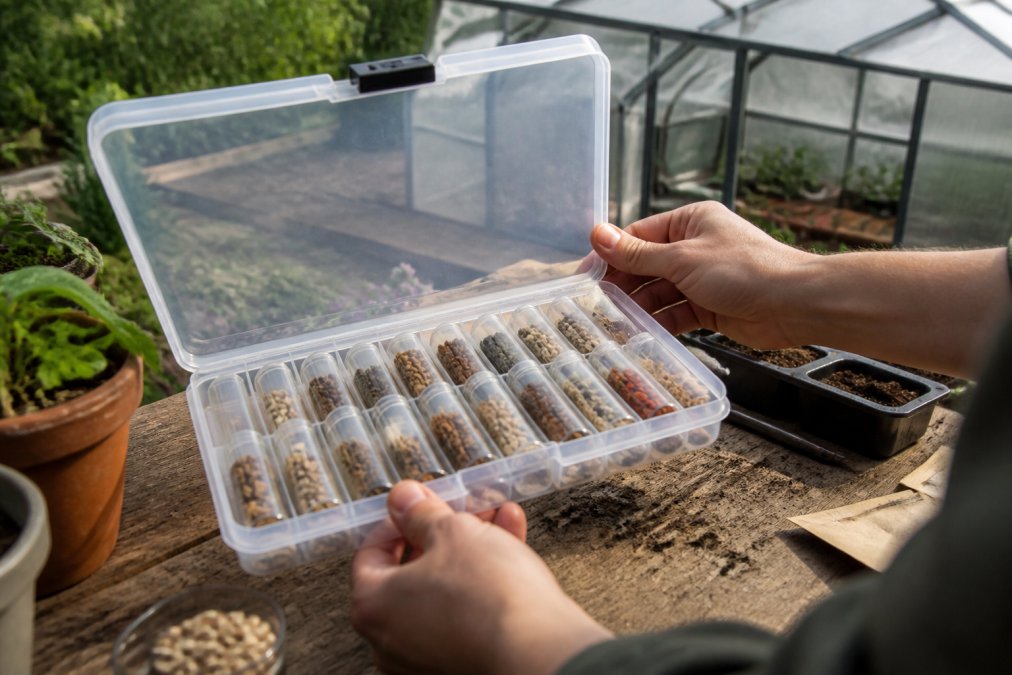
A moisture-proof seed organizer outperforms DIY options because it controls humidity on purpose instead of by accident. Shoe boxes, zip bags, and repurposed jars can work, but each one leaves a gap in protection.
DIY storage problems show up in predictable ways:
- Cardboard and paper absorb ambient moisture and pass it to seeds
- Zip bags seal unevenly and lose their grip after repeated opening
- Mismatched jars make labeling and sorting slow
- Nothing stacks, so the collection spreads across shelves
A dedicated organizer fixes all four at once. The WALERICA kit includes envelopes, labels, and essential tools, so you are not hunting for supplies after the box arrives. Setup takes minutes, and the water-resistant design holds up in a greenhouse or a humid garage.
Labeling, Organization, and Pest Protection
Labeling is what turns a pile of seeds into a usable library. Without it, you end up with unmarked envelopes and no idea what is inside.
Build your system around three habits:
- Label each vial with variety name and the year saved
- Group by type, such as vegetables, herbs, and flowers, so you can find a category fast
- Keep a master index, either on paper or in a notes app, listing what is stored where
Pest protection is the other half. Seeds attract pantry moths, beetles, and rodents. A sealed outer case blocks most insects, and individual capped vials stop any that get inside from spreading. If you live in an area with heavy rodent pressure, store the organizer on a shelf rather than the floor.
Transparent containers help here too. You can scan a row of vials and spot a problem before it spreads, which is much harder with opaque boxes.
Conclusion
Building a seed collection that lasts is a challenge, especially in humid climates and fluctuating temperatures. The right container removes most of that risk.
Moderno Top Shop built the WALERICA Seed Storage Organizer Kit for exactly this job. It organizes up to 120 varieties, includes envelopes, labels, and essential tools, and uses a water-resistant design that travels from home shelf to greenhouse without fuss. Setup takes minutes, so you can get back to planting.
Get started with Moderno Top Shop and keep every seed protected, labeled, and ready for the next growing season.
Frequently Asked Questions
How long do seeds typically remain viable in storage?
Most vegetable seeds stay viable for 2-5 years when stored properly. Onions and parsnips decline fastest, often losing viability within 1-2 years. Beans, cucumbers, and tomatoes can last 4-6 years in ideal conditions. The key factors are consistent low humidity and stable cool temperatures. A moisture-proof seed organizer with airtight vials slows the aging process significantly compared to paper envelopes left in a drawer.
What features should I look for in a moisture-proof seed organizer?
Prioritize an airtight seal, UV-blocking or opaque materials, and individual compartments that limit air exposure per variety. Look for BPA-free plastic or glass construction, a gasket or screw-top closure, and enough slots to separate varieties without crowding. Labeling surfaces or included labels matter too, since misidentified seeds waste an entire planting season. A durable seed storage box with 120 slots handles large collections without mixing.
Can plastic seed storage boxes prevent pest damage?
Yes. Hard plastic containers with tight-fitting lids block mice, beetles, and moths that chew through paper bags and cardboard. The seal also keeps out pantry pests attracted to dried seed material. For extra protection, inspect seeds before storing and discard any with visible holes or webbing. A sealed organizer removes the access point pests rely on, making it far more effective than open trays or fabric pouches.
How do I organize my seed collection for easy access?
Sort by plant family or planting season first, then alphabetically within each group. Use individual vials or envelopes for each variety and label with the variety name plus the year saved. Group cool-season crops together and warm-season crops together so you grab one section per planting window. A compartment organizer with 120 slots lets you dedicate rows to categories like tomatoes, peppers, herbs, and flowers without reshuffling everything each spring.
