
Best Way to Store 100+ Seed Varieties in 2026
Table of Contents
- Why Storing 100+ Seed Varieties Demands a Real System
- Ideal Storage Conditions: Temperature, Humidity, and Darkness
- Best Seed Storage Containers for Large Collections
- How to Organize Garden Seeds: Labeling, Inventory, and FIFO Rotation
- Long Term Seed Storage Tips: Desiccants, Testing, and Prep
- Seed Viability Chart: How Long Each Variety Lasts
- Conclusion
- Frequently Asked Questions
Last Updated: October 1, 2026
Why Storing 100+ Seed Varieties Demands a Real System
To store 100 seed varieties is a logistics problem disguised as a gardening task. A handful of envelopes in a shoebox works fine for ten packets. At one hundred, that same shoebox becomes a liability: you lose track of what you have, you plant expired seed, and you waste an entire season on varieties that stopped being viable years ago.
- Moisture content of the seed itself before it goes in
- Relative humidity of the surrounding air
- Temperature stability, not just coldness
- Physical organization, so you can find and rotate what you have
Ideal Storage Conditions: Temperature, Humidity, and Darkness
The target for most vegetable and flower seed is a cool, dark, dry environment held steady over time. Three conditions matter most.
Why Constant Temperature Beats Cold Spikes
A refrigerator that gets opened twenty times a day is worse than a cool closet. Every opening lets warm, humid air in; when the door closes, that moisture condenses on the coldest surface, which is often your seed containers. A temperatura constante in a dedicated mini-fridge or a cool interior room beats an erratic cold environment every time. If you use a shared fridge, store seed in an insulated box inside it to buffer those swings.
Best Seed Storage Containers for Large Collections
The best seed storage containers for a large collection are airtight, opaque, and modular enough to scale past 100 varieties without becoming a filing nightmare. The container is what separates a working collection from a pile of bags.

Vials, Mylar Bags, Glass Jars, and Modular Boxes
Each container type solves a different problem, and most serious collections use more than one.
| Container | Best For | Trade-off |
|---|---|---|
| Glass vials | Small quantities, easy viewing | Breakable, needs a box |
| Bolsas mylar | Long-term, moisture-proof | Hard to reseal once opened |
| Frascos de vidrio | Bulk seed, large lots | Heavy, takes shelf space |
| Modular boxes | 100+ varieties, organization | Needs labels to work |
How to Organize Garden Seeds: Labeling, Inventory, and FIFO Rotation
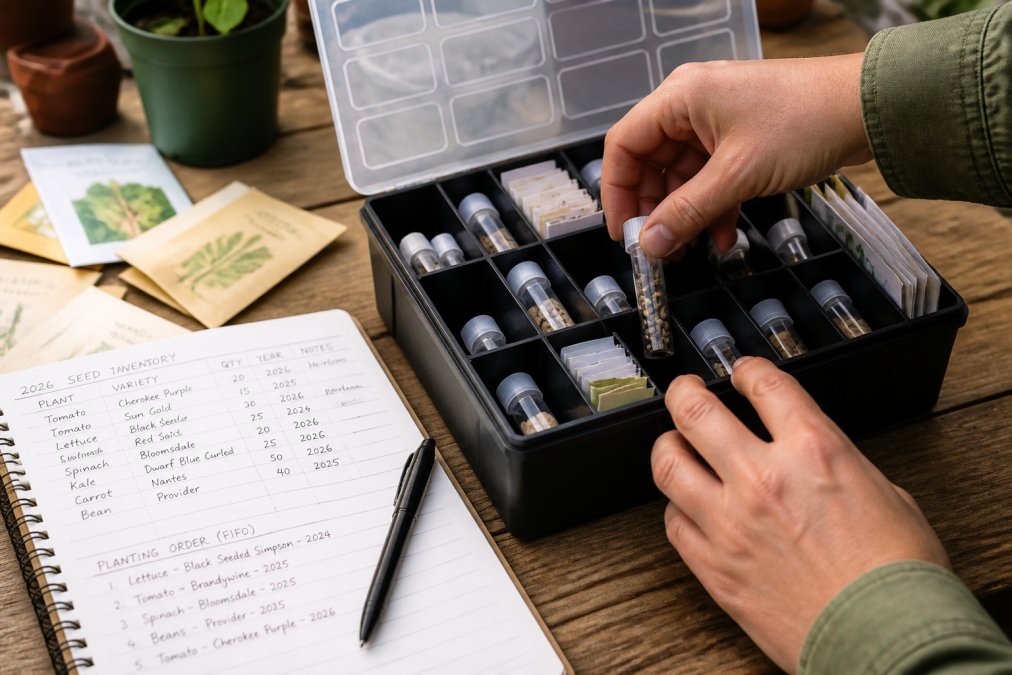
The best way to store 100 seed varieties is to label every container with variety and harvest date, log each lot in a simple inventory, and rotate stock on a first-in, first-out basis. Organization is what keeps a 100-variety collection usable instead of decorative. At this scale, the difference between a working collection and a decorative one is almost never the storage container, it's the system layered on top of it.
Building a Simple Inventory for 100+ Varieties
A spreadsheet with six columns handles almost any home collection:
- Variety name and botanical type
- Harvest date (month and year is enough)
- Lot number or source
- Quantity remaining (count of seeds or approximate fill level)
- Viability window for that species
- Physical slot number where the vial lives
A Rotation Trigger You Can Actually Follow
Most people fail at FIFO because they never define when to rotate. A simple rule that works: at the start of each planting season, pull every lot whose harvest date is older than half its viability window and schedule it for a germination test (see the viability section below). Anything that passes goes to the front of its species group and gets planted that season.
Labeling That Survives a Season
Ink fades, tape peels, and permanent marker bleeds on damp vials. A label that lasts needs three things: the variety name, the harvest year, and the slot number. Write on the outside of the vial, not on a bag inside it, so you can read it without opening anything. A strip of painter's tape over a marker label adds a layer of protection against humidity and handling.
Modular Storage That Scales With the Collection
At 100+ varieties, the container has to do more than seal. It has to let you find one vial without disturbing ninety-nine others. Modular compartment boxes with removable vials solve this: each vial is a self-contained unit, and the box is just the shelf. When a variety is retired, you pull one vial and drop in a replacement, no re-sorting, no re-labeling the whole box.
Long Term Seed Storage Tips: Desiccants, Testing, and Prep
Long term seed storage works when you control moisture before sealing, use a desiccant to absorb what's left, and test viability on a schedule. Prep is where most collections succeed or fail, and at 100+ varieties, testing is where most collections quietly fall apart, because a germination test that uses ten seeds from a lot you only have fifteen of is a test that costs you the variety.
How to Test Viability Without Wasting the Reserve
The standard germination test, count out ten seeds, place them on a damp paper towel, keep warm and moist, count sprouts, works fine when you have hundreds of seeds. It does not work when you have fifteen seeds of a rare variety and need to know whether they're still alive.
WALERICA Seed Storage Organizer Kit →
A reserve-safe approach:
- Sample the smallest useful number. Five seeds is enough to detect a lot that has dropped below roughly half its original germination. If four or five sprout, the lot is healthy. If two or three sprout, plant it thickly. If zero or one sprout, the lot is effectively dead.
- Test the oldest lot first. You only need to test lots approaching their viability window, not the whole collection. A lot harvested last year doesn't need a test.
- Test in batches by species. Cucurbits, nightshades, and brassicas germinate at similar rates and temperatures, so you can run several lots side by side on the same damp towel, labeled with a marker.
- Keep the test warm and dark. A consistent 70-75°F is enough for most vegetable seed. A warm closet shelf works; a windowsill does not, because temperature swings skew results.
Reading the Results
A germination percentage is only useful if you act on it. A simple decision rule:
- 80% or higher: plant normally.
- 50-79%: plant thickly and thin later, or use the lot for microgreens.
- Below 50%: plant the entire lot in one season, or replace it.
- Zero: discard and refill the slot.
Watch for Mold and Pests
Mold signals excess moisture; insects usually arrive with field debris. Inspect stored seed a few times a year, and pull any vial showing clumping, discoloration, or fine webbing. A single moldy vial can spread spores to its neighbors inside a sealed box, so isolate it immediately rather than leaving it in place.
Seed Viability Chart: How Long Each Variety Lasts
A seed viability chart tells you how long each variety typically stays germinable under good storage, so you know what to plant first and what to replace. These are general ranges; actual viabilidad depends on how well you stored the seed.
| Variety Group | Typical Viability |
|---|---|
| Onion, parsnip, leek | 1-2 years |
| Corn, pepper, carrot | 2-3 years |
| Bean, pea, tomato | 3-4 years |
| Cucumber, squash, melon | 4-5 years |
| Beet, chard, radish | 4-5 years |
Conclusion
Managing 100+ varieties is a genuine challenge: without a system, even a well-stocked collection turns into anonymous, expired seed within a couple of seasons. Moderno Top Shop built the WALERICA kit to solve exactly that problem, with 120 labeled vials, a water-resistant modular case, and the labels and tools included so setup takes minutes, not an afternoon. Whether you keep 30 varieties or 120, the container is what makes labeling, FIFO rotation, and moisture protection practical instead of aspirational.
Frequently Asked Questions
What is the best way to store 100 seed varieties?
Use a modular system with individual sealed vials or Mylar bags, kept in an opaque container in a cool, dark spot at around 40-50°F with low humidity. Label every vial with variety name and harvest date, and keep a master inventory list. This setup lets you store 100 seed varieties without mixing them up or losing track of what you have.
How long can you store vegetable seeds before they lose viability?
It depends on the variety. A seed viability chart shows that beans, cucumbers, and lettuce often last 3-5 years, while onions and parsnips drop to 1-2 years. Stored in airtight, dark, cool conditions with a desiccant like silica gel, many seeds stay viable longer. Test germination yearly to confirm which lots still perform.
Should seeds be stored in plastic or glass containers?
Both work if the seal is airtight. Glass jars with rubber gaskets block moisture and odors well, while opaque plastic vials are lighter and easier to label in bulk. For 100+ varieties, individual vials inside a larger airtight box give you the best of both: sealed protection per variety and one organized container to manage.
How do I label and track 100 different seed varieties?
Give each variety a unique code (for example, TOM-01 for the first tomato), write it on the vial label along with the harvest year, and log it in a notebook or spreadsheet. Sort vials by category (vegetables, herbs, flowers) and use a first-in, first-out rotation so older lots get planted first.
Do I need a desiccant for long term seed storage?
Yes, a desiccant helps. Silica gel packets absorb moisture inside the container and keep relative humidity low, which slows seed aging. Recharge silica gel every few months by drying it in an oven, and never let seeds touch the packet directly. This is one of the most effective long term seed storage tips for humid climates.
Can I store seeds in the refrigerator or freezer?
The refrigerator works for most home gardeners if seeds are in airtight, moisture-proof containers. Freezing is riskier because ice crystals can damage seeds if any moisture remains. If you use a fridge, keep seeds away from fruits that release ethylene, and let containers reach room temperature before opening to avoid condensation.
