
Benefits of Using Seed Organizers for Gardeners
Table of Contents
- Why Seed Organizers Matter for Your Garden
- Protection Against Moisture and Pests with Seed Organizers
- Seed Storage Tips for Home Gardeners
- Seed Viability and Storage Duration Explained
- Essential Gardening Tools for Seed Savers
- Organization and Labeling Systems for Seed Collections
- Cost-Effectiveness and Space Use of Seed Organizers
- DIY vs. Professional Storage Solutions
- Climate-Specific Storage Advice
- Conclusion: Start Organizing Your Seeds Today
- Frequently Asked Questions
Last Updated: October 2, 2026
Why Seed Organizers Matter for Your Garden
A seed organizer keeps seed packets and vials separated, labeled, and protected from moisture, light, and pests, solving the biggest cause of wasted seed: poor storage that kills germination rates before planting season.
Most gardeners buy seeds in spring, plant half the packet, and stuff the rest into a drawer or plastic bag. By next season those leftovers have lost much of their vigor.
Keep reading because the payoff is real: seeds that stay dry and cool can remain viable for years instead of months.
Organizing changes three things:
- Protection: sealed containers block moisture and pests
- Findability: labels mean you plant what you intended
- Efficiency: a sorted collection saves time every season
Protection Against Moisture and Pests with Seed Organizers
Moisture is the number one enemy of stored seed. When humidity creeps in, seeds absorb it, triggering mold, rot, and early sprouting.
Pests are the second threat: mice, moths, and weevils treat a bag of seeds as a meal. Airtight containers remove the smell and access that attract them.
Airtight Containers and Desiccants for Moisture Control
Airtight containers and desiccants work together: the container blocks outside air, while a desiccant absorbs moisture already trapped inside. Silica gel packets are the most common choice and can be reused by drying them out.
Here's how to set it up:
- Make sure seeds are fully dry before storing them
- Add a small desiccant packet to each container
- Seal the lid tightly
- Check packets every few months and swap when saturated
The National Center for Home Food Preservation recommends keeping stored seeds cool and dry, since fluctuating humidity does more damage than steady conditions.
Seed Storage Tips for Home Gardeners
Good seed storage comes down to four factors: cool temperatures, low humidity, darkness, and consistency. Get those right and your seeds will outlast their printed expiration dates.

- Keep seeds out of direct sunlight
- Store away from heat sources like furnaces or water heaters
- Use sealed containers, not open bags
- Label everything with the variety and the year
- Keep a small desiccant in each container
A common mistake is treating the fridge as a cure-all. Fridges are humid, and unless seeds are in a truly sealed container, that moisture does more harm than good.
Temperature Control and Environmental Factors
Temperature control matters because heat speeds up the reactions that drain a seed's stored energy. Every ten degrees of extra warmth can shorten shelf life. Steady and cool beats cold and fluctuating.
- Temperature: aim for a stable, cool spot
- Humidity: keep it low with desiccants
- Light: store in the dark
- Air: seal containers to limit exposure
A closet shelf in a climate-controlled room works well for most gardeners.
Seed Viability and Storage Duration Explained
Seed viability and storage duration depend on seed type, storage conditions, and age. Beans and tomatoes hold for several years; onions and parsnips lose vigor fast and are best used within a season or two.
The cooler and drier the storage, the longer the seed lasts. Under good conditions, many vegetable seeds stay viable three to five years; under poor conditions, that window shrinks to a single season.
| Seed Type | Typical Storage Life | Best Storage Condition |
|---|---|---|
| Beans, peas | 3-5 years | Cool, dark, sealed |
| Tomatoes | 4-6 years | Cool, dark, sealed |
| Onions | 1-2 years | Cool, dry, sealed |
| Parsnips | 1 year | Cool, dry, sealed |
| Lettuce | 3-4 years | Cool, dark, sealed |
Testing Germination Rates at Home
Testing germination rates at home takes about a week and costs nothing, telling you whether an old packet is worth planting.
Here's the paper towel method:
- Count out ten seeds from the packet
- Dampen a paper towel and fold the seeds inside
- Place it in a sealed bag or container
- Keep it warm, around room temperature
- Check after 7 to 10 days
Count how many seeds sprout. Six of ten means roughly 60% germination, plant thicker to compensate, or start fresh if the rate is very low.
Essential Gardening Tools for Seed Savers
Essential gardening tools for seed savers go beyond a trowel and gloves. If you collect and store your own seed, a few small tools keep your collection clean and sorted.
- Labels: for variety names and dates
- Small vials or jars: for individual varieties
- A funnel: for pouring seed without spills
- Tweezers: for handling tiny seeds
- A notebook: for tracking what you saved and when
- Planting markers: for the garden itself
A common mistake is skipping labels. Six months later, every unmarked envelope looks the same, and you're guessing whether it's basil or broccoli.
This is where a kit that bundles everything together saves time.
Organization and Labeling Systems for Seed Collections
A labeling system turns a pile of packets into a usable collection.
- Group seeds by type: vegetables, herbs, flowers
- Within each group, sort alphabetically
- Label every container with variety and year
- Keep a master list in your notebook
- Store the oldest seed at the front so you use it first
For larger collections, note how much of each variety you have and when you planted it, so you reorder before running out and stop buying duplicates.
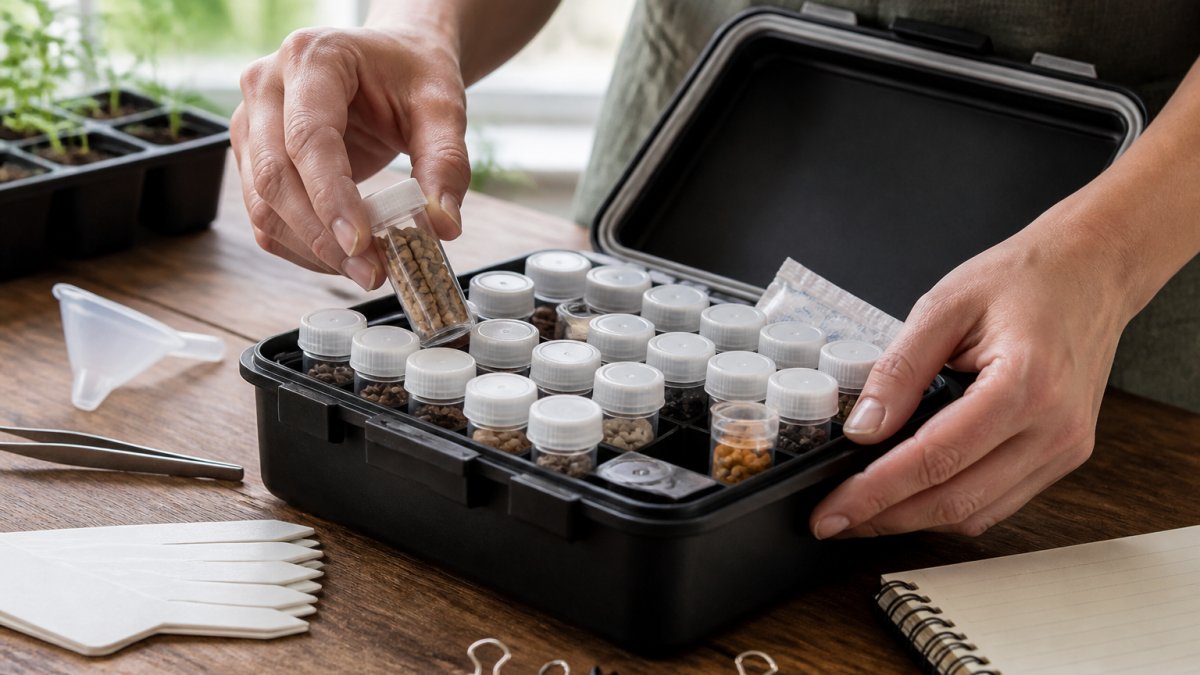
The WALERICA kit holds up to 120 individual vials, which is enough to organize a serious collection without losing track of anything.
WALERICA Seed Storage Organizer Kit with 120 Seed Containers – Seed Organizer →
Cost-Effectiveness and Space Use of Seed Organizers
A seed organizer pays for itself by saving the seeds you already bought.
Space use matters just as much. A tidy organizer stacks vertically and fits on a shelf, while loose bags sprawl across drawers and counters.
Compare the two approaches:
| Factor | Loose Bags and Boxes | Dedicated Seed Organizer |
|---|---|---|
| Space used | Scattered, hard to stack | Compact, vertical |
| Seed protection | Minimal | Sealed and dry |
| Findability | Guesswork | Labeled and sorted |
| Replacement cost | High, seeds spoil | Low, seeds last |
The WALERICA Seed Storage Organizer Kit, priced at $49.99, replaces a drawer full of mystery envelopes with one water-resistant box and 120 labeled vials.
DIY vs. Professional Storage Solutions
Most guides say "just use jars and bags" or "just buy a kit" without doing the math.
| DIY Option | Seal Quality | Stackability | Labeling | Best For |
|---|---|---|---|---|
| Mason jars | Excellent if the lid gasket is intact | Poor, heavy and awkward | Write on lid or tape | Small collections under ~20 varieties |
| Zip-top bags | Poor, permeable over time | None | Marker smears | Short-term, one-season use |
| Repurposed tins | Fair, depends on fit | Fair | Tape labels peel | Decorative storage, not preservation |
| Photo storage boxes | None on their own | Excellent | Slots hold labeled packets | Packet storage in dry rooms |
| Dedicated vial organizer | Excellent, gasketed lid plus individual vials | Excellent | Built-in label slots | Collections that grow past ~30 varieties |
The hidden cost in DIY is labor, not containers. Mismatched jars and tins don't stack, so you lose shelf space. Handwritten labels fade or fall off, so you re-identify varieties every season. Lids that no longer seal let moisture in, so you lose seed you thought was protected.
A simple way to decide:
- Count your current varieties.
- Add the number you plan to save next season.
- If the total stays under about 20 and you already own sealable jars, DIY is genuinely fine, just add a desiccant and label the lids.
- If the total crosses roughly 30, or you save seed from more than one garden, a matched system starts paying for itself in time saved and seed not lost.
DIY wins for very small collections, seed planted within a single season, and gardeners with a stash of matching jars. A dedicated organizer wins for collections that grow every year, seed kept three or more seasons, and anyone tired of guessing what's in an unmarked envelope.
The WALERICA Seed Storage Organizer Kit sits on the "dedicated" side of that line. It is not the cheapest way to store ten packets, but it is the simpler choice once your collection outgrows mismatched containers.
Climate-Specific Storage Advice
Seed storage advice is usually written as if every gardener lives in the same climate. A setup that works in a dry high-desert climate fails in a humid coastal one.
The core principle: seeds absorb and release moisture until they reach equilibrium with the air around them. The relative humidity of your storage space sets the ceiling on how dry your seed stays, and temperature controls how fast the seed's stored energy is consumed.
Humid Climates
In humid regions, moisture control is the whole game. Desiccants are the primary defense, not optional.
- Use a gasketed, airtight container, not a zip bag or tin.
- Add a fresh desiccant packet to each container, not just one per shelf.
- Recharge or replace desiccants every two to three months in peak summer humidity.
- Keep the container closed, every time you open it, humid air rushes in.
- Avoid garages, basements, and sheds, which track outdoor humidity closely.
If silica gel packets feel soft or the indicator beads have changed color, they are saturated and no longer protecting anything.
Arid Climates
In dry regions, humidity is less of a threat, but temperature swings are. Day-night and seasonal swings cause condensation inside containers, and that condensation damages seed.
- Prioritize a stable indoor location over an aggressively dry one.
- A closet in a climate-controlled room beats a garage shelf, even though the garage is drier.
- Seal containers to buffer against temperature swings, not just humidity.
- Desiccants are still useful, but you can use fewer and recharge them less often.
Hot Climates
Heat accelerates the reactions that drain a seed's stored energy, and every additional ten degrees shortens shelf life. In hot climates, move seed out of unconditioned spaces.
- Get seed out of garages, sheds, and attics.
- A cool interior closet is usually the best available spot.
- If you must store in a warm room, use a sealed container with a desiccant and test germination more often.
Cold Climates
Cold is generally friendly to seed, but frost and condensation are not.
- Keep containers sealed so temperature changes do not pull moisture onto the seed.
- Avoid unheated outbuildings where freeze-thaw cycles cause condensation.
- A damp cold space is worse than a dry cool one.
A Quick Climate Decision Guide
| Climate | Top Priority | Second Priority | Desiccant Frequency |
|---|---|---|---|
| Humid | Moisture control | Darkness | Every 2-3 months |
| Arid | Temperature stability | Darkness | Every 4-6 months |
| Hot | Cool location | Moisture control | Every 3-4 months |
| Cold | Condensation control | Temperature stability | Every 4-6 months |
The Cornell Cooperative Extension notes that storage conditions often matter more than the seed's age when it comes to germination. That is the reason climate deserves its own section rather than a single line of advice.
Conclusion: Start Organizing Your Seeds Today
The hardest part of seed storage isn't the science. It's building a system you'll actually keep up with season after season. Loose bags and forgotten drawers waste seed, money, and the varieties you worked to save.
WALERICA Seed Storage Organizer Kit makes that system simple.
Get started with WALERICA Seed Storage Organizer Kit and keep every variety protected, labeled, and ready to plant.
Frequently Asked Questions
Why is it important to maintain a home seed bank?
A home seed bank preserves genetic diversity and ensures you have seeds for future plantings, especially for heirloom varieties. Proper storage in seed organizers keeps seeds viable for years, saving money and providing food security. It also allows you to share and trade seeds with other gardeners, fostering community resilience.
How does proper seed storage extend the viability of vegetable seeds?
Proper seed storage reduces exposure to moisture, heat, and pests, which slow seed degradation. Using airtight containers and controlling temperature can extend viability from one season to several years. For example, tomato seeds stored correctly can remain viable for up to five years, while onions may last only one to two years. A seed organizer helps maintain these conditions consistently.
What are the primary benefits of using a dedicated seed organizer?
A dedicated seed organizer keeps seeds sorted, labeled, and protected from environmental factors. It prevents cross-contamination, makes inventory management easy, and saves time during planting. The WALERICA Seed Storage Organizer Kit holds up to 120 varieties in individual vials, includes labels and tools, and is water-resistant, making it a practical solution for home gardeners.
How do seed storage kits help prevent cross-contamination?
Seed storage kits use individual containers or compartments to keep each seed variety separate. This prevents physical mixing and reduces the risk of pests or diseases spreading between seeds. Labeling each container further ensures you know exactly what you're planting, maintaining the purity of your seed collection.
