

Seed Organizer: High-Quality Storage for Every Gardener
Table of Contents
- Why a High-Quality Seed Organizer Changes Your Garden Routine
- What to Look for in a Premium Seed Storage Box
- Seed Storage Best Practices for Maximum Viability
- How to Organize Garden Seeds by Season and Type
- The Walerica 120-Slot Seed Organizer Kit Review
- Long-Term Seed Storage Tips for Rare and Heirloom Varieties
- Common Seed Storage Mistakes to Avoid
- Get Your Seed Collection Ready for Next Season
- Frequently Asked Questions
Last Updated: September 5, 2026
Why a High-Quality Seed Organizer Changes Your Garden Routine
A seed organizer is more than a storage box; it is the difference between a chaotic drawer of mixed packets and a planting season that starts on time. For gardeners who save seeds across multiple seasons, the cost of disorganization is measured in missed germination windows and duplicated purchases.
The core problem most gardeners face is not a lack of seeds, but a lack of visibility. A high-quality organizer solves this by giving every variety a dedicated, labeled home, which directly supports seed viability by reducing unnecessary handling and exposure to light and air.
What to Look for in a Premium Seed Storage Box
Choosing the right container comes down to protecting your seeds from the three main threats: moisture, temperature swings, and physical damage. A premium seed storage box addresses all three through its construction and internal design.

Capacity and Vial Quality
The number of slots dictates how granular your organization can be. A box holding 30 varieties forces you to group different crops together, which often leads to confusion later. Systems with 100 or more individual vials let you separate varieties, harvest years, and even specific plant lines. Look for thick vial walls that resist cracking and a secure seal that keeps contents dry.
Material Durability and Moisture Protection
The housing material determines how well the box survives a drop from a shelf or a humid summer day. High-density plastics, like EVA or polypropylene, offer a strong balance of rigidity and light weight. The real defense against humidity comes from the seals on the individual vials; check that the case closes tightly and that the vials have gaskets or a snap-fit lid that creates an airtight barrier.
Seed Storage Best Practices for Maximum Viability
Most storage advice stops at "keep seeds cool and dry," but the actual science of seed longevity hinges on specific environmental thresholds. The guiding principle is the "Rule of Thumb" often cited in seed banking: for every 10°F increase in storage temperature, seed lifespan roughly halves. Conversely, for every 1% decrease in seed moisture content (within a safe range), lifespan roughly doubles.
The Three Environmental Killers: Heat, Humidity, and Light
Heat accelerates the metabolic activity inside the embryo, burning through the seed's finite energy reserves. The practical target for most home gardeners is a stable temperature between 40°F and 50°F, not room temperature. A cool basement corner or an interior closet on a north-facing wall often achieves this.
Humidity is the more insidious threat. Seeds are hygroscopic; they absorb and release moisture from the air. For most garden seeds, an RH between 20% and 40% is ideal. Above 60% RH, mold and premature sprouting become real risks. A simple, inexpensive hygrometer placed near your organizer gives you a concrete number to monitor rather than guessing.
Light triggers germination cues in many species. Even brief exposure to bright light can begin the process of breaking dormancy. This is why opaque or dark-colored organizers are not just an aesthetic choice; they are a functional barrier. If you use a clear organizer for visibility, store it inside a closed cupboard or a cardboard box to block light entirely.
The Desiccant Trade-Off: Silica Gel vs. Clay
Adding a desiccant packet is a common tip, but not all desiccants perform equally. Silica gel is the standard choice because it adsorbs moisture effectively down to about 20% RH and is reusable, you can dry it out in a low oven (200°F for 2 hours) and use it again. Clay desiccants are cheaper but less effective at reaching the low RH levels seeds prefer. A 5-gram silica packet per 120-slot case is usually sufficient; more than that can over-dry seeds and cause the seed coat to crack.
The Refrigerator Method: A Step Beyond
For seeds you intend to keep for more than one season, a dedicated refrigerator is the gold standard. The key is to use a sealed mason jar or a large Ziploc bag inside the fridge, with a desiccant, to buffer against the fridge's humidity cycles (which typically run 50-70% RH). Never store seeds in the fridge door, where temperature swings are most extreme. Allow the sealed container to come to room temperature for 30 minutes before opening it; this prevents condensation from forming on the cold seeds.
Testing Viability Before You Plant
A simple home germination test saves you from wasting a planting window on dead seed. Place 10 seeds on a damp paper towel, fold it, and seal it in a plastic bag. Keep it in a warm spot (70-75°F) and check daily for 7-14 days. If fewer than 7 out of 10 sprout, the seed lot is marginal; plant thicker or replace it.
How to Organize Garden Seeds by Season and Type
A seed organizer is only as good as the filing system behind it. Sorting by season and crop type is the baseline, but the real competitive edge comes from building a system that mirrors your actual planting calendar.
The Seasonal Workflow Method
Instead of a static alphabetical arrangement, structure your organizer around the flow of your growing year. Divide the case into four zones: Cold Hardy (plant 4-6 weeks before last frost), Warm Season (plant after last frost), Fall/Winter (plant in late summer), and Perennial/Undecided. When the soil temperature hits 50°F in early March, the first zone you see is exactly what needs to go into the ground.
Within each seasonal zone, sort by days-to-maturity (DTM). Place your 55-day lettuce next to your 70-day carrot so that when you harvest one, you know the other is ready to fill the gap. This transforms your organizer from a storage bin into a planting schedule.
Professional Labeling: Beyond Variety and Year
A label that says "Tomato, Brandywine, 2025" is a good start, but a professional seed inventory system captures four additional data points:
- Source or Seed Company: Knowing whether a seed came from a commercial packet or a neighbor's garden tells you about disease resistance and genetic stability.
- Germination Rate (if known): For saved seed, write the date you tested it and the percentage. A lot testing at 85% can be planted normally; one at 60% needs to be sown thicker.
- Days to Maturity: This is the single most useful number for planning. Write it on the label so you do not have to remember that "Rutgers" tomatoes take 75 days but "Cherokee Purple" takes 85.
- Harvest Year and Seed Generation: For saved seed, note whether it is F1, F2, or open-pollinated. This matters for maintaining true-to-type characteristics in heirloom varieties.
Use a fine-tip permanent marker or a label maker. Pencil fades on plastic vials. Write the label before you fill the vial, not after, so you never have a mystery seed.
The "Seed Library" Index Card System
For collections exceeding 50 varieties, a paper index card system kept inside the organizer lid or in a nearby binder provides a searchable backup. Number each slot in the organizer (1-120) and keep a corresponding card for each number. On the card, record the full data set: variety, source, harvest year, DTM, germination test date and result, and any notes on disease resistance or flavor. When you use the last of a seed, pull the card. This prevents buying duplicate seed because you forgot you already had it.
A Calendar-Based Rotation Strategy
Set a recurring reminder on your phone or calendar for the first week of each month. When it fires, open the organizer and check two things: (1) which seeds need to be planted this month based on your zone's frost dates, and (2) which seeds are approaching their second year in storage and should be prioritized for planting or replaced. This monthly audit takes five minutes.
This system turns a simple box of vials into a personal seed bank with a documented chain of custody, the kind of rigor that commercial seed savers use, adapted for a home gardener's workflow.
The Walerica 120-Slot Seed Organizer Kit Review
For gardeners ready to move beyond repurposed jars and rubber bands, the Walerica Seed Storage Kit offers a complete, turnkey solution. Available through Moderno Top Shop for $49.99, this kit holds up to 120 individual seed varieties, making it suitable for both casual hobbyists and serious heirloom collectors.
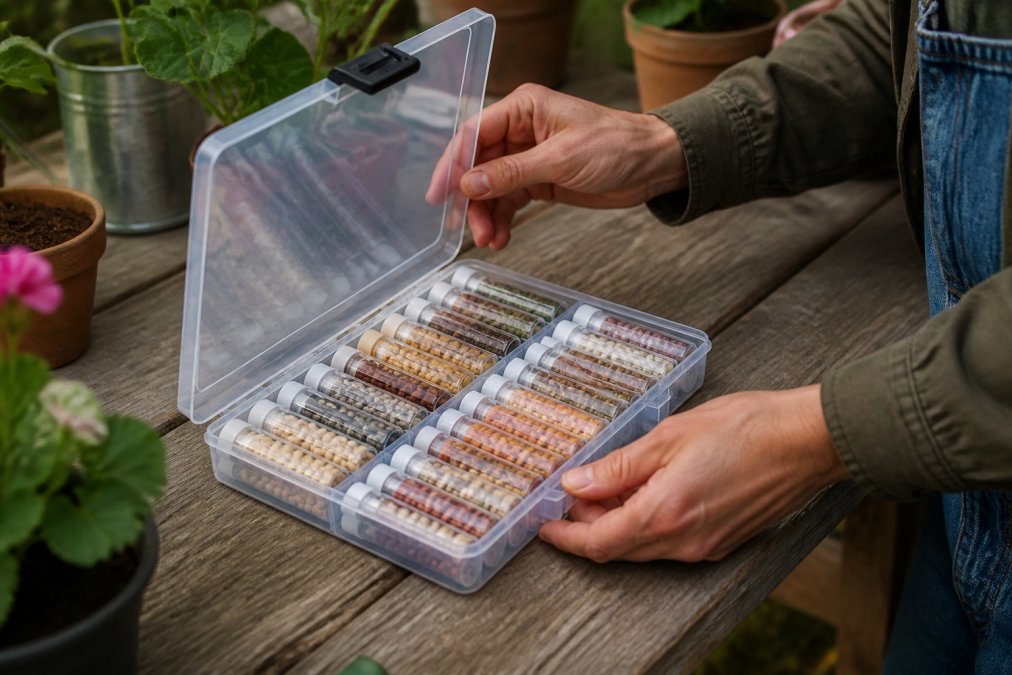
The kit includes everything you need to set up your system immediately: 120 clear vials, pre-printed labels, and a funnel for transferring seeds without spillage. The case itself is built from a durable, water-resistant material that holds up well to the bumps and drops of a busy gardening season. Setup takes minutes.
What sets this organizer apart is the clarity of the vials. Being able to see the seed color, size, and quantity at a glance eliminates the need to open every container to find what you are looking for. This visual inventory saves significant time during the planning phase of your garden. For those who currently rely on a mix of envelopes and plastic bags, this kit consolidates everything into one portable, protective case.
Long-Term Seed Storage Tips for Rare and Heirloom Varieties
Collecting rare or heirloom seeds is an investment in genetic diversity that requires a longer-term storage strategy. While a standard seed organizer is excellent for seasonal use, seeds intended for preservation over several years need extra consideration.
For seeds you plan to keep for more than two years, consider moving them to a cooler environment. Some gardeners use a dedicated refrigerator for this purpose, placing their organizer inside a sealed container with a desiccant to control humidity. This method slows the aging process considerably.
It is also wise to practice seed rotation. Use your oldest seeds first, and refresh your stock of heirloom varieties every few years by planting them out and saving new seed. This not only keeps your collection viable but also ensures you are actively growing and preserving the genetics you value. The USDA factsheet on seed storage notes that temperature and moisture are the two critical factors influencing how long seeds remain viable in storage.
Common Seed Storage Mistakes to Avoid
Even with the right equipment, a few common errors can undermine your efforts. The most frequent mistake is storing seeds in areas with high temperature fluctuations, which causes condensation and reduces viability.
Another pitfall is mixing old and new seeds without proper dating. Without a harvest year on the label, you cannot prioritize which seeds to plant first. Finally, do not overlook the importance of keeping the organizer closed when not in use. Leaving the lid open exposes seeds to ambient humidity and pests.
Get Your Seed Collection Ready for Next Season
Organizing your seeds is a yearly task that pays dividends in time saved and successful germination. Whether you are a home gardener with a few dozen packets or a greenhouse operator managing hundreds of varieties, a dedicated seed organizer is the foundation of a productive season.
The Walerica 120-Slot Seed Organizer Kit simplifies this process by combining durable construction with a complete labeling and storage system. With a water-resistant case and room for 120 varieties, it is a practical investment for anyone looking to protect their seeds and simplify their planting routine. Get your seed collection ready for the next season with the Walerica kit from Moderno Top Shop.
Frequently Asked Questions
What is the best way to store seeds long-term?
The best method combines a cool, dry, and dark environment with airtight containers. A high-quality seed organizer with sealed vials protects seeds from humidity and light. For extended storage, keep the organizer in a consistent climate around 40-50°F, like a cool closet or basement, rather than a garage where temperatures fluctuate. Always ensure seeds are completely dry before sealing them in vials to prevent mold.
Do seed storage containers need to be airtight?
Yes, airtight containers are critical for protecting seed viability. Seeds absorb moisture from the air, which can trigger premature germination or cause rot. A seed organizer with rubber-gasketed lids or tightly sealed vials creates a barrier against humidity. For extra protection in humid climates, you can add a small silica gel packet inside the organizer to absorb any residual moisture and keep the internal environment stable.
How many seed varieties can a standard storage organizer hold?
This depends on the model. Entry-level organizers might hold 20 to 40 small vials, while premium kits like the Walerica Seed Organizer offer 120 individual slots. That capacity suits gardeners with large collections or those who save seeds from multiple harvests. If you have a smaller collection, a larger organizer still provides room to grow and keeps everything consolidated in one protective case.
Should I store my seed organizer in the refrigerator?
Refrigeration can extend seed life, but only if the environment is dry. The humidity inside a standard fridge is often too high for unprotected seeds. If you do use a refrigerator, place your seed organizer in an airtight secondary container with a desiccant pack. This prevents moisture from reaching the seeds. Allow the container to reach room temperature before opening it to avoid condensation forming on the seeds.
Organizing your seed collection is a challenge every gardener faces, but it does not have to be a recurring struggle. A quality system eliminates the guesswork and protects your investment in seeds. At Moderno Top Shop, we recommend the Walerica 120-Slot Seed Organizer Kit for its durable, water-resistant design and comprehensive labeling tools. Get started with the Walerica kit and bring order to your garden planning today.
