

Seed Storage: Protect From Humidity and Temperature
Table of Contents
- Why Humidity and Temperature Matter for Seed Storage
- Ideal Seed Storage Temperature and Why It Works
- Managing Humidity to Prevent Seed Deterioration
- Best Containers for Seed Storage and Moisture Control
- How to Test Seed Viability Before Planting
- Long-Term vs. Short-Term Seed Storage Strategies
- Setting Up a Home Seed Storage System That Works
- Frequently Asked Questions
Last Updated: September 4, 2026
Why Humidity and Temperature Matter for Seed Storage
Seed storage humidity and temperature are the two variables that determine whether your seeds remain viable for the next season or turn into a disappointing tray of mold. Seeds are living organisms in a dormant state. When exposed to excess moisture or heat, they either respire too quickly, depleting their stored energy, or they rot before you ever get them in the ground.

The science is straightforward: seeds are hygroscopic, meaning they absorb moisture from the air around them. In a humid environment, that absorbed moisture triggers premature metabolic activity. The seed believes it is spring and starts spending its energy reserves. By the time you actually plant it, there is nothing left to fuel germination.
At Moderno Top Shop, we offer solutions to help home gardeners protect their collections. The core principle we always return to is consistency. Seeds tolerate a stable, slightly cool environment far better than they tolerate dramatic swings in either direction. This guide from Moderno Top Shop covers the practical steps to get your seed storage humidity and temperature dialed in correctly, whether you have ten packets or a hundred varieties.
Ideal Seed Storage Temperature and Why It Works
The ideal seed storage temperature for most garden varieties sits between 32°F and 41°F. At this range, metabolic activity slows to a near standstill, preserving the embryo and its food supply for years rather than months. A refrigerator set to its normal setting often lands in this zone, which is why it remains the most accessible tool for the home gardener.
A common mistake is freezing seeds to extend their life. While freezing works for some species, it can damage seeds with high moisture content. The ice crystals rupture cell walls. Unless you have properly dried seeds to a very low moisture content, skip the freezer entirely.
The relationship between temperature and moisture is the key insight. As a rule of thumb, the sum of the storage temperature in Fahrenheit and the relative humidity percentage should stay below 100. At Moderno Top Shop, we recommend keeping your storage space cool and dark, since light exposure can also trigger germination cues in some species.
Managing Humidity to Prevent Seed Deterioration
Relative humidity inside your storage container matters more than almost any other factor because moisture directly triggers metabolic activity in dormant seeds. When a seed absorbs water, its respiration rate increases exponentially. The seed's stored carbohydrates and proteins, its only fuel source, begin to break down as the seed "wakes up" metabolically. In high-humidity environments, this process accelerates seed aging by months or even years. Above 60 percent relative humidity, most seeds deteriorate rapidly, losing vigor and becoming susceptible to fungal growth that can render them completely nonviable.
The target range for long-term storage is 20 to 40 percent relative humidity. At 30 percent humidity and 41°F, a seed's aging process slows to approximately one-tenth the rate it would experience at room temperature and 60 percent humidity. This is why the combination of cool temperature and low humidity is non-negotiable for seeds you plan to keep beyond one season.
Measuring humidity in your storage space requires a simple tool: a digital hygrometer. A basic hygrometer costs $8 to $15 and provides real-time readings of the relative humidity percentage inside your container or storage location. Place the hygrometer in your seed storage area for at least one week across different seasons to establish a baseline. If your readings consistently exceed 50 percent, your location is unsuitable for long-term storage without intervention. If readings fluctuate by more than 15 percentage points between seasons, you need a sealed container or a climate-controlled space.
Moisture control starts before storage. Seeds must be thoroughly dry. A simple test is the snap test: press a seed with your fingernail. A properly dry seed snaps cleanly. A seed that bends or feels rubbery still contains too much moisture and needs more drying time before you seal it away. For gardeners in naturally humid regions, those living in areas with average humidity above 55 percent year-round, this drying step is critical and often requires active intervention. Spread seeds on a paper towel in a warm, dry room (around 70°F) for 48 to 72 hours before storage, or use a food dehydrator set to the lowest temperature (95°F to 105°F) for 4 to 6 hours.
Silica gel packets are the most accessible tool for absorbing residual moisture inside sealed containers. A standard 5-gram silica gel packet can absorb moisture from approximately one quart of air space. You can also use dry rice in a cloth sachet as a DIY alternative, though rice is less effective and requires replacement every 3 to 4 months. The goal is to create a stable, low-humidity microclimate inside your container. Check your desiccant periodically, silica gel changes color from blue or orange to pink or green when saturated, and replace it once it stops absorbing. For gardeners in naturally humid regions, this is where storage fails most often. The exterior environment constantly pushes moisture inward. A sealed container is not optional; it is the only defense against slow, invisible moisture intrusion.
Adapting to regional climate challenges: If you live in a region with seasonal humidity swings (such as coastal areas or the humid South), consider storing seeds in a basement or interior closet where humidity is more stable than in above-ground rooms. If your home lacks a naturally cool, dry space, a small wine cooler or compact refrigerator dedicated to seed storage maintains both temperature and humidity stability year-round. Some gardeners in high-humidity climates add a second desiccant packet and replace it every 2 to 3 months rather than annually, accepting the minor cost as insurance against crop failure.
Best Containers for Seed Storage and Moisture Control
The best containers for seed storage create an airtight seal and block light. Glass mason jars with rubber gaskets are excellent and affordable. Metal tins with tight lids work well. Avoid plastic bags, which are permeable to moisture over time, and cardboard envelopes, which absorb humidity from the air.
Airtight does not mean moisture-proof forever. The seal protects against ambient humidity, but any moisture trapped inside at sealing time remains. This is why the drying step before storage is so critical.
For gardeners managing a larger collection, a dedicated seed storage box simplifies the entire process. The WALERICA Seed Storage Organizer Kit from Moderno Top Shop provides 120 individual vials, each designed to keep varieties separate and labeled. The water-resistant case adds a layer of protection against accidental spills or high-humidity environments, and the included envelopes and labels mean you can organize your entire collection in a single session.
The key advantage of a vial-based system is that you only open one variety at a time. The rest of the collection remains sealed and undisturbed, preserving the stable environment you have created.
| Container Type | Airtight? | Light Protection | Best For |
|---|---|---|---|
| Glass mason jar | Yes | No | Short-term, cool dark spaces |
| Metal tin | Yes | Yes | General home storage |
| Plastic bag | No | No | Avoid for long-term |
| Seed organizer kit | Yes | Yes | Collections over 30 varieties |
How to Test Seed Viability Before Planting
Testing seed viability before planting saves you from wasted effort and empty growing trays. More importantly, it tells you whether your storage conditions have been working. Poor results point directly back to your humidity and temperature practices, not the seeds themselves.
The germination test (paper towel method) is the most reliable home test for overall viability. Place ten seeds on a damp paper towel, fold it over, and seal it in a plastic bag. Keep the bag in a warm spot, around 70°F, and check daily. Most common garden seeds germinate within seven to fourteen days. Count how many seeds sprout. If eight out of ten germinate, you have an 80 percent germination rate, which is excellent. Five or fewer out of ten suggests the seed lot is weak. You can either sow more densely to compensate or replace the seeds entirely.
Visual and tactile signs of moisture damage appear before you run a germination test. Inspect seeds for discoloration, soft spots, or visible mold before storage and again before planting. Seeds damaged by excess humidity often develop a dull, chalky surface or dark spots. If you notice these signs, the seed has likely begun to rot internally, and germination rates will be very low. Squeeze a seed gently between your fingers; a seed weakened by moisture damage will feel slightly soft or compressible rather than hard and firm. These are warning signs that your storage humidity exceeded safe levels.
Diagnosing storage failure: If your germination test shows a sharp drop compared to the previous season, for example, 90 percent germination last year but only 40 percent this year, humidity or temperature fluctuations are the likely culprit. Compare your results against the expected germination rate for that seed variety (most seed packets list this). If your actual rate is significantly lower, review your storage location for temperature swings, moisture intrusion, or light exposure. Check your desiccant; if it is saturated or missing, that explains the failure. If your storage location's humidity exceeded 50 percent for extended periods, seeds will age rapidly regardless of temperature.
The cold test for vigor is a secondary check for seeds stored long-term. Soak ten seeds in cool water for 24 hours, then place them on a damp paper towel in a sealed bag at 50°F (a refrigerator shelf works well) for 7 to 10 days. Seeds that germinate under these cool, moist conditions have retained vigor. Seeds that fail to germinate under cool conditions but succeed at room temperature have lost some vigor, a sign of aging accelerated by poor storage conditions. This test is particularly valuable for older seeds that have been through multiple storage cycles or seeds stored in regions with high humidity.
Keeping records: Document the germination rate for each seed variety and storage year. Over time, you will see patterns. If a particular variety consistently shows declining germination rates year over year, either your storage conditions are unsuitable for that species, or you need to replace the seed lot more frequently. Heirloom or rare varieties often have lower initial germination rates than commercial seeds, so establish a baseline for each variety rather than assuming all seeds should perform identically.
Long-Term vs. Short-Term Seed Storage Strategies
Short-term storage, meaning seeds you plan to use within the next planting season, is forgiving. A cool, dry, dark cupboard is usually sufficient. The seeds will maintain acceptable viability over a few months without elaborate equipment.
Long-term storage, defined as keeping seeds viable for multiple years, demands stricter conditions. This is where the 32°F to 41°F temperature range and 20 to 40 percent humidity become non-negotiable. For heirloom varieties or rare species you want to preserve, the effort is worth it.
The difference comes down to how fast seeds age. At room temperature and normal household humidity, most seeds lose significant viability within two years. Under proper refrigeration and moisture control, the same seeds can remain viable for five to ten years or longer. The investment in a good container and a consistent environment pays for itself many times over.
Setting Up a Home Seed Storage System That Works
A reliable home seed storage system has three components: dry seeds, airtight containers, and a stable location. Begin by sorting your collection and discarding any seeds that show signs of damage or mold. Next, verify your seeds are fully dry using the snap test from earlier.
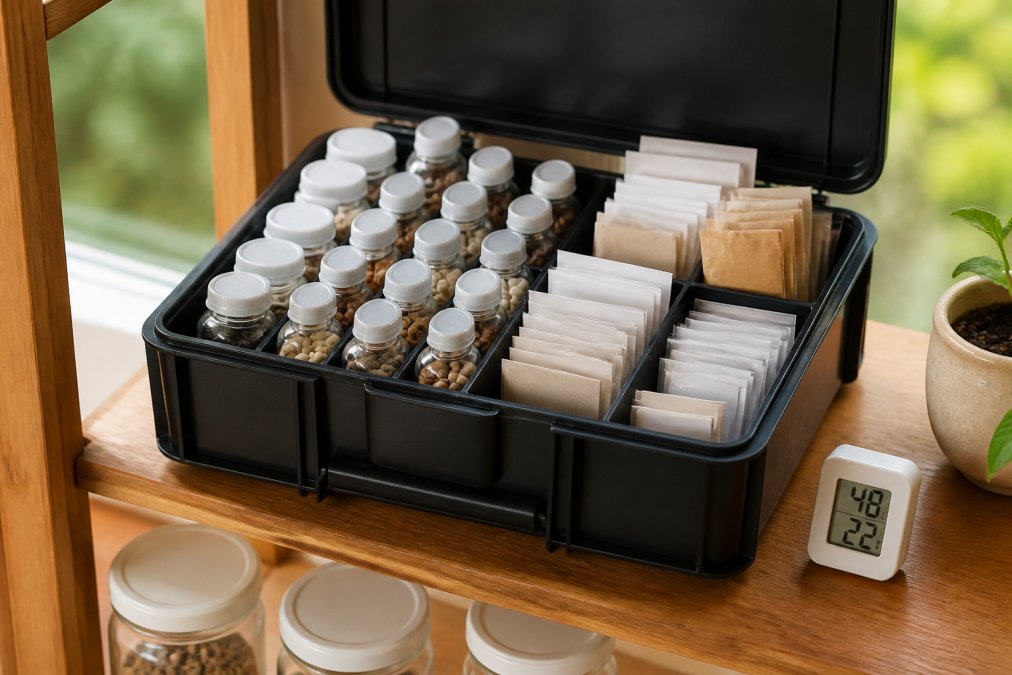
Your storage location matters as much as your containers. A basement corner or an interior closet is often cooler than an exterior wall or a garage. Avoid areas near heat sources, water pipes, or windows. Check the temperature and humidity in your chosen spot across different seasons to confirm it remains stable.
Finally, label everything. A seed collection without labels is just a box of mysteries. Record the variety and the date you stored it. This single habit prevents the frustration of planting unknown seeds and helps you track which lots need to be used first.
For gardeners ready to move beyond shoeboxes and rubber bands, the WALERICA Seed Organizer Kit consolidates these best practices into one system. Its 120 vials, water-resistant case, and included labeling tools align with the storage principles outlined above, making it a practical choice for organizing and protecting your collection through every season.
Protecting your seeds from humidity and temperature is the difference between a thriving garden and a season of disappointment. Whether you are saving a few prized varieties or building a library of dozens, the fundamentals remain the same: dry seeds, sealed containers, and a cool, stable environment. Moderno Top Shop offers the WALERICA Seed Storage Organizer Kit with 120 vials, water-resistant construction, and an easy setup that takes minutes, so your collection stays organized, labeled, and ready for planting season. Get started with your WALERICA kit and give your seeds the protection they deserve.
Frequently Asked Questions
What is the ideal temperature for long-term seed storage?
The ideal seed storage temperature ranges between 32°F and 41°F (0°C to 5°C), with 40°F (4°C) considered optimal for most vegetable and flower seeds. Cold temperatures slow the seed's metabolic rate, extending viability for years. A standard refrigerator maintains this range perfectly. For seeds you plan to use within one season, room temperature (68°F to 72°F) works if humidity stays below 50%.
How does humidity affect seed viability over time?
High humidity accelerates seed deterioration by promoting moisture absorption, which triggers premature germination or fungal growth. Relative humidity above 60% significantly reduces seed longevity. Seeds are hygroscopic, meaning they absorb moisture from the air. Keeping humidity between 30% and 40% preserves vigor and extends storage life. A dehumidifier or airtight containers with desiccant packets maintain these conditions effectively.
How can I tell if my stored seeds are still viable?
The simplest test is the water germination method: place 10 seeds on a damp paper towel, roll it, and keep it warm and moist for 7-10 days. Count how many sprout. If 8 out of 10 germinate, your seeds have 80% viability. For faster results, cut seeds in half, viable seeds show a white or cream-colored interior. Discolored or hollow seeds have lost viability. Conduct this test before planting a large area to avoid wasted effort.
What type of container best protects seeds from moisture?
Airtight glass jars, vacuum-sealed bags, and moisture-proof vials work best for seed storage. The WALERICA Seed Storage Organizer uses individual sealed vials that keep each variety separate and protected from humidity shifts. Avoid paper envelopes or cardboard boxes, which absorb moisture. For maximum protection, add a desiccant packet (silica gel) inside your container to absorb any residual moisture. Label everything clearly so you can track storage dates and variety germination rates.
